


FACTivity – Owl-ch!
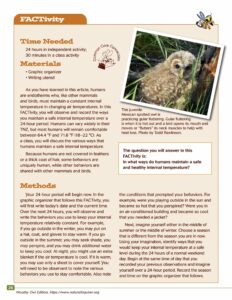
As you have learned in "Owl-ch!," humans are endotherms who, like other mammals and birds, must maintain a constant internal temperature in changing air temperatures. In this FACTivity, you will observe and record the ways you maintain a safe internal temperature over a 24-hour period.
The question you will answer in this FACTivity is: In what ways do humans maintain a safe and healthy internal temperature?
Materials:
- Graphic organizer (included)
- A writing utensil

Standards addressed in this Activity:
-
HS-ESS3-1
Construct an explanation based on evidence for how the availability of natural resources, occurrence of natural hazards, and changes in climate have influenced human activity.
-
Follow precisely a complex multistep procedure when carrying out experiments, taking measurements, or performing technical tasks; analyze the specific results based on explanations in the text.
-
Follow precisely a multistep procedure when carrying out experiments, taking measurements, or performing technical tasks.
-
Follow precisely a complex multistep procedure when carrying out experiments, taking measurements, or performing technical tasks, attending to special cases or exceptions defined in the text.
-
Initiate and participate effectively in a range of collaborative discussions (one-on-one, in groups, and teacher-led) with diverse partners on grades 11-12 topics, texts, and issues, building on others' ideas and expressing their own clearly and persuasively.
-
Integrate multiple sources of information presented in diverse formats and media (e.g., visually, quantitatively, orally) in order to make informed decisions and solve problems, evaluating the credibility and accuracy of each source and noting any discrepancies among the data.
-
Present information, findings, and supporting evidence, conveying a clear and distinct perspective, such that listeners can follow the line of reasoning, alternative or opposing perspectives are addressed, and the organization, development, substance, and style are appropriate to purpose, audience, and a range of formal and informal tasks.
-
Adapt speech to a variety of contexts and tasks, demonstrating a command of formal English when indicated or appropriate. (See grades 11-12 Language standards 1 and 3 here for specific expectations.)
-
Engage effectively in a range of collaborative discussions (one-on-one, in groups, and teacher-led) with diverse partners on grade 6 topics, texts, and issues, building on others' ideas and expressing their own clearly.
-
Interpret information presented in diverse media and formats (e.g., visually, quantitatively, orally) and explain how it contributes to a topic, text, or issue under study.
-
Present claims and findings, sequencing ideas logically and using pertinent descriptions, facts, and details to accentuate main ideas or themes; use appropriate eye contact, adequate volume, and clear pronunciation.
-
Adapt speech to a variety of contexts and tasks, demonstrating command of formal English when indicated or appropriate. (See grade 6 Language standards 1 and 3 for specific expectations.)
-
Engage effectively in a range of collaborative discussions (one-on-one, in groups, and teacher-led) with diverse partners on grade 7 topics, texts, and issues, building on others' ideas and expressing their own clearly.
-
Analyze the main ideas and supporting details presented in diverse media and formats (e.g., visually, quantitatively, orally) and explain how the ideas clarify a topic, text, or issue under study.
-
Present claims and findings, emphasizing salient points in a focused, coherent manner with pertinent descriptions, facts, details, and examples; use appropriate eye contact, adequate volume, and clear pronunciation.
-
Adapt speech to a variety of contexts and tasks, demonstrating command of formal English when indicated or appropriate. (See grade 7 Language standards 1 and 3 here for specific expectations.)
-
Engage effectively in a range of collaborative discussions (one-on-one, in groups, and teacher-led) with diverse partners on grade 8 topics, texts, and issues, building on others' ideas and expressing their own clearly.
-
Analyze the purpose of information presented in diverse media and formats (e.g., visually, quantitatively, orally) and evaluate the motives (e.g., social, commercial, political) behind its presentation.
-
Present claims and findings, emphasizing salient points in a focused, coherent manner with relevant evidence, sound valid reasoning, and well-chosen details; use appropriate eye contact, adequate volume, and clear pronunciation.
-
Adapt speech to a variety of contexts and tasks, demonstrating command of formal English when indicated or appropriate. (See grade 8 Language standards 1 and 3 here for specific expectations.)
-
Initiate and participate effectively in a range of collaborative discussions (one-on-one, in groups, and teacher-led) with diverse partners on grades 9-10 topics, texts, and issues, building on others' ideas and expressing their own clearly and persuasively.
-
Integrate multiple sources of information presented in diverse media or formats (e.g., visually, quantitatively, orally) evaluating the credibility and accuracy of each source.
-
Present information, findings, and supporting evidence clearly, concisely, and logically such that listeners can follow the line of reasoning and the organization, development, substance, and style are appropriate to purpose, audience, and task.
-
Adapt speech to a variety of contexts and tasks, demonstrating command of formal English when indicated or appropriate. (See grades 9-10 Language standards 1 and 3 here for specific expectations.)
-
People, Places, and Environments
Lend a Hand, Care for the Land
Here are some ideas for how you can lend a hand to help owls. Discuss these ideas with your parents or caregivers. You can tell them about owls and what you learned in this article.
1. If you have a chimney, ask your parents or caregivers to install a chimney cap. A chimney cap will prevent owls, other birds, and other wildlife from getting trapped in your chimney.
2. Take down soccer nets when you are not using them. Owls get caught in nets, and in soccer nets especially. Make sure that soccer nets are not out at night, when owls are most active.
3. Do not use poisons around your home. Owls may eat poisoned animals and be poisoned themselves.
4. Keep your cats indoors. Cats hunt birds and other wildlife, including owls.