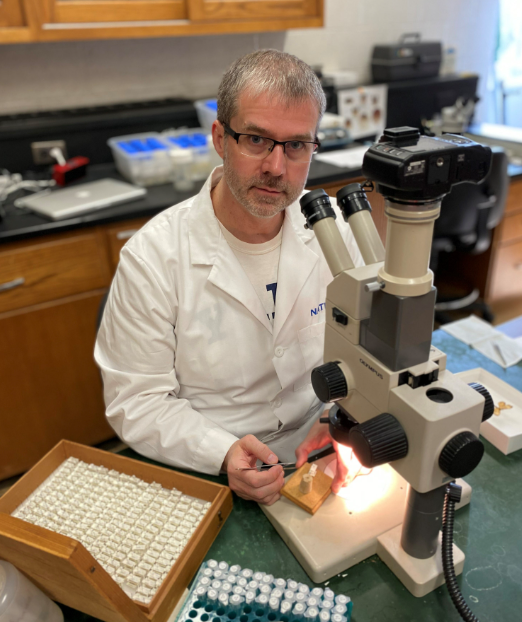
As a molecular ecologist, I use genetic data to study how species interact, including how introduced species move around the world.
The skills that help me most in my research are excitement in making new discoveries and efficient use of time. You can make even more fun discoveries if you can gather and analyze quality data quickly!
When a new pest arrives from another part of the world, it is important to quickly learn about it. I have tried to answer questions like, “Where did hemlock woolly adelgid (a pest that kills hemlock trees) come from?” and “Could the predators that feed on it where it came from be brought here to get it under control?
I use DNA sequencing technology in my research. One piece of equipment that we use often is a robot that extracts DNA from insects. It sure makes that part of the DNA sequencing process much quicker!
I discovered where exactly the hemlock woolly adelgid came from. I used DNA to show it came to the eastern U.S. from Japan, and that it is also native to western North America. This pointed to both regions as sources of predators that might control the adelgid in the East.
When I was young, I had a friendly competition with my friend to have the best insect collection. That was the beginning, but when I took a class in college called “Plant Interactions,” I was hooked. That’s when I was sure that I wanted to study the science of plant-insect interactions.