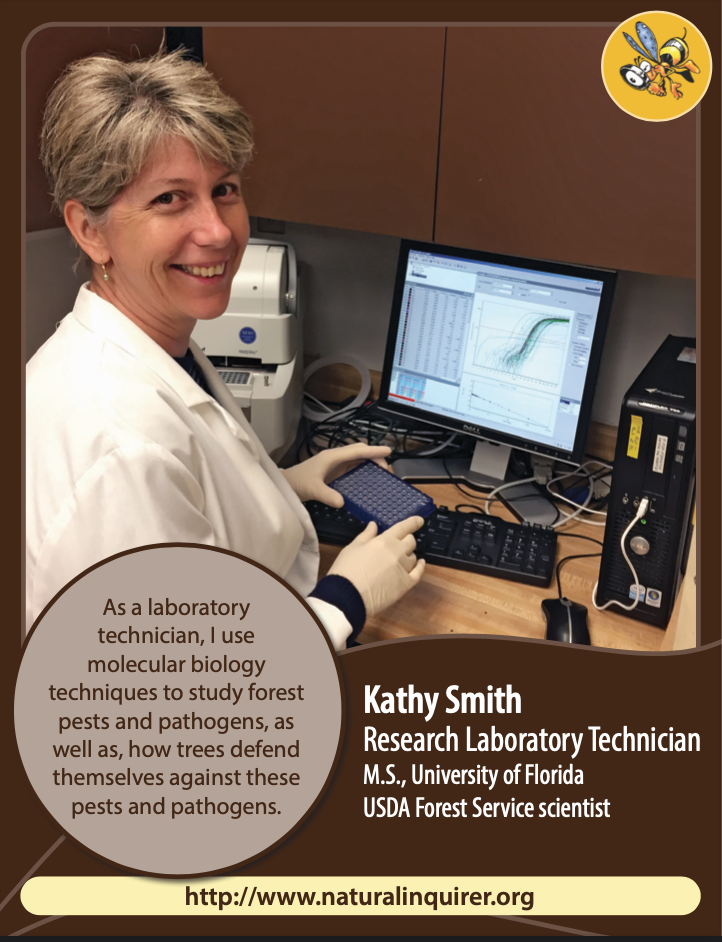
As a laboratory technician, I use molecular biology techniques to study forest pests and pathogens, as well as, how trees defend themselves against these pests and pathogens.
I am organized and good at visualizing a process, including how each step affects the other steps. I am energized by thinking about new problems and the enthusiasm of the scientists working on them.
When a tree survives laurel wilt disease, do seeds from that tree grow into trees that are resistant to fungus or beetle attack? Laurel wilt disease is caused by a fungus that is carried by an invasive bark beetle. This disease is killing trees across the southeastern United States. We are using trees that have survived outbreaks to study the tree genetics and disease resistance.
I often use thermocyclers. Thermocyclers are common laboratory machines that can be programmed many different ways to amplify DNA from plants, insects, and fungi. Amplified DNA are copies of particular parts of an organism’s DNA.
While studying a fungus that infects both pine stems and oak leaves, I showed that the same set of fungal genes are active in both cases. This discovery is interesting given that oak is very different from pine and that stems are very different from leaves.
Biology was my favorite subject in school. After college, when I started working in a research laboratory, I realized how much I liked this type of work. Lab work is a bit like cooking, one of my favorite hobbies.