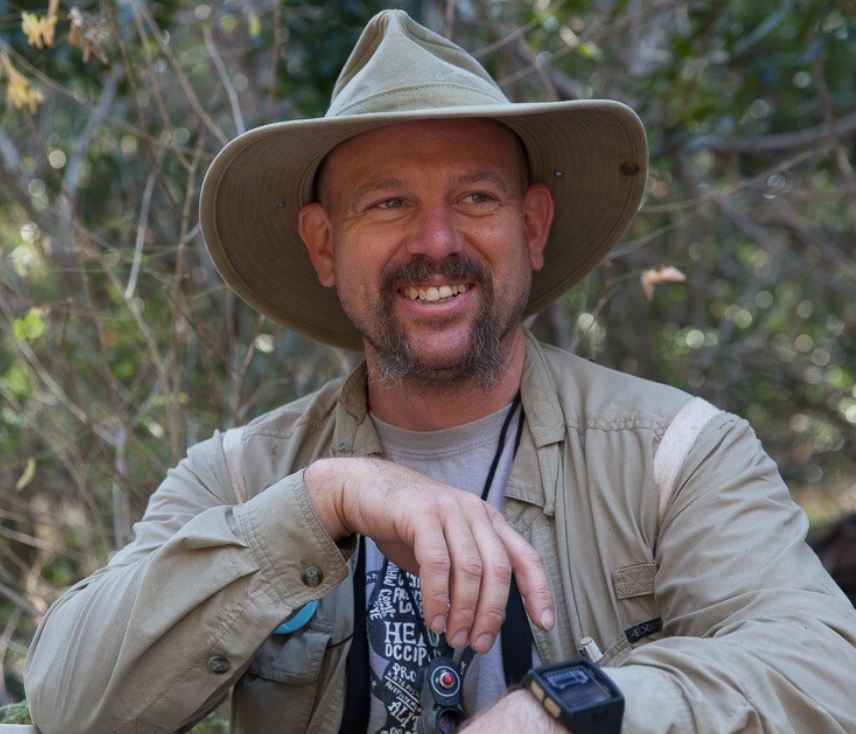
Doug Booher, Ecologist, Entomologist, and Evolutionary Biologist
Ph.D., University of California, Los Angeles
USDA Forest Service
As an ecologist and an entomologist, I study the functional importance native ants provide to ecosystems and the impacts invasive species have on native ant communities. As a taxonomist, I describe new ant species.
Being able to program and code statistics might be the most useful skill I have as I use it for every research project. Maybe the most important skill is being able to work in collaboration with other scientists that have skills necessary to complete large research projects.
What makes nonnative ants (ants that arrived in the U.S. from other countries) successful? Some introduced ants, like fire ants, spread and become problems while others don’t. I found that introduced ants that spread the most cooperated with other colonies of their same species.
To view the internal musculature and structures of very small insects, I use a micro-CT scanner (like an x-ray machine for little things). It takes thousands of images, like slices through the inside of an ant. These images combine to make 3-D images one can explore.
Every project is exciting as each one answers a question previously unknown. Naming new species is one of the parts of my research I really love. Discovering that trap-jaw ants have evolved many times through relatively small morphological changes was a highlight.
I have always been curious but didn’t pursue the education needed to be a scientist until I was 38 years old.