


Explore & Download All Collector Cards
Browse our ever-growing list of collector cards featuring a huge variety of careers in the Forest Service. Download and print collector cards and posters for free.

-

 Fire
FireSmokey Bear, Wildfire Prevention Specialist
- Wildfire Prevention Specialist
- As a wildfire prevention specialist, I raise public awareness about how human behavior can accidentally cause a wildfire. My goal is for humans to be aware of their actions and take personal responsibility to prevent wildfires.
- Wildfire Prevention Specialist
- As a wildfire prevention specialist, I raise public awareness about how human behavior can accidentally cause a wildfire. My goal is for humans to be aware of their actions and take personal responsibility to prevent wildfires.
-
 Wildlife
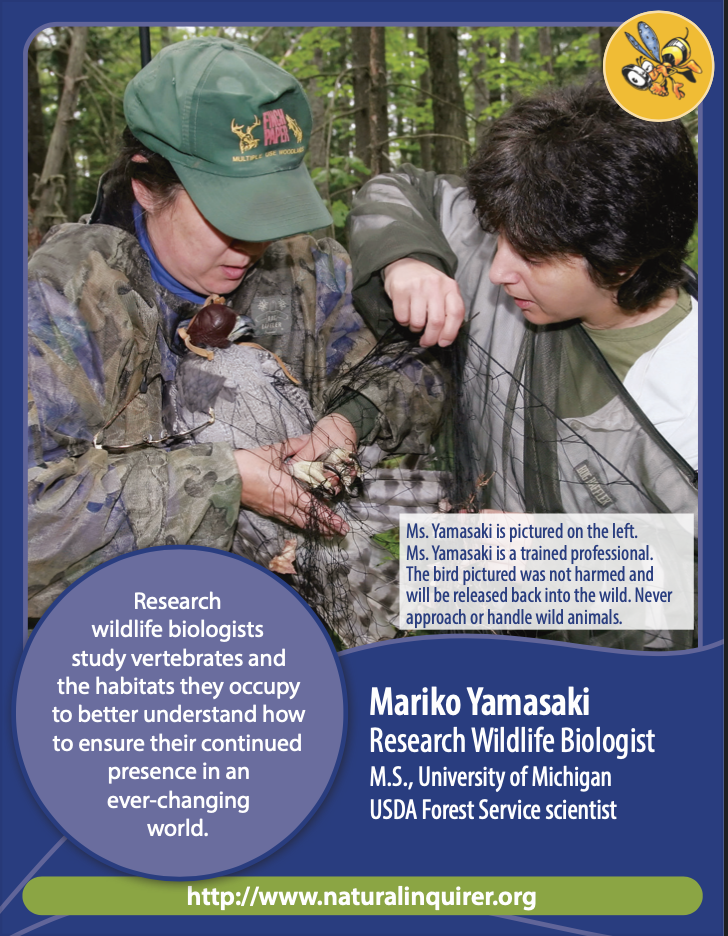
Mariko Yamasaki, Research Wildlife Biologist
- M.S., University of Michigan
- USDA Forest Service Scientist
- Research wildlife biologists study vertebrates and habitats they occupy to better understand how to ensure their continued presence in an ever-changing world.
- M.S., University of Michigan
- USDA Forest Service Scientist
- Research wildlife biologists study vertebrates and habitats they occupy to better understand how to ensure their continued presence in an ever-changing world.
-

 Wildlife
Joseph Wunderle, Wildlife Ecologist & Conservation Biologist
- Ph.D., University of Minnesota
- USDA Forest Service Scientist
- We study wildlife populations and their relationships with their physical and living environment to identify what might cause populations to increase or decrease. We apply these research findings to help endangered species’ populations to increase.
- Ph.D., University of Minnesota
- USDA Forest Service Scientist
- We study wildlife populations and their relationships with their physical and living environment to identify what might cause populations to increase or decrease. We apply these research findings to help endangered species’ populations to increase.
-

 Forests & PlantsWildlife
Ted Weller, Ecologist
- M.S., Humboldt State University
- USDA Forest Service Scientist
- An ecologist studies the interaction between animals, their environment, and the weather. In my work, I study how those interactions change among seasons.
- M.S., Humboldt State University
- USDA Forest Service Scientist
- An ecologist studies the interaction between animals, their environment, and the weather. In my work, I study how those interactions change among seasons.
-

 Wildlife
Mel Warren, Fisheries & Aquatic Ecologist
- Ph.D., Southern Illinois University, Carbondale
- USDA Forest Service Scientist
- As a fisheries and aquatic ecologist, I study fishes and freshwater mussels in their natural habitats to learn about their life cycles, needs for survival, roles in the ecosystem, and how we can conserve them.
- Ph.D., Southern Illinois University, Carbondale
- USDA Forest Service Scientist
- As a fisheries and aquatic ecologist, I study fishes and freshwater mussels in their natural habitats to learn about their life cycles, needs for survival, roles in the ecosystem, and how we can conserve them.
-

 Wildlife
Frank R. Thompson III, Wildlife Biologist
- Ph.D., University of Missouri-Columbia
- USDA Forest Service Scientist
- A wildlife biologist studies wild animals and their habitats to provide the knowledge needed to conserve or manage wildlife species.
- Ph.D., University of Missouri-Columbia
- USDA Forest Service Scientist
- A wildlife biologist studies wild animals and their habitats to provide the knowledge needed to conserve or manage wildlife species.
-

 Wildlife
John R. Squires, Research Wildlife Biologist
- Ph.D., University of Wyoming
- USDA Forest Service Scientist
- A wildlife biologist studies how ecological and human-caused factors affect wildlife management and conservation, usually in natural habitats.
- Ph.D., University of Wyoming
- USDA Forest Service Scientist
- A wildlife biologist studies how ecological and human-caused factors affect wildlife management and conservation, usually in natural habitats.
-

 Forests & PlantsWaterWildlife
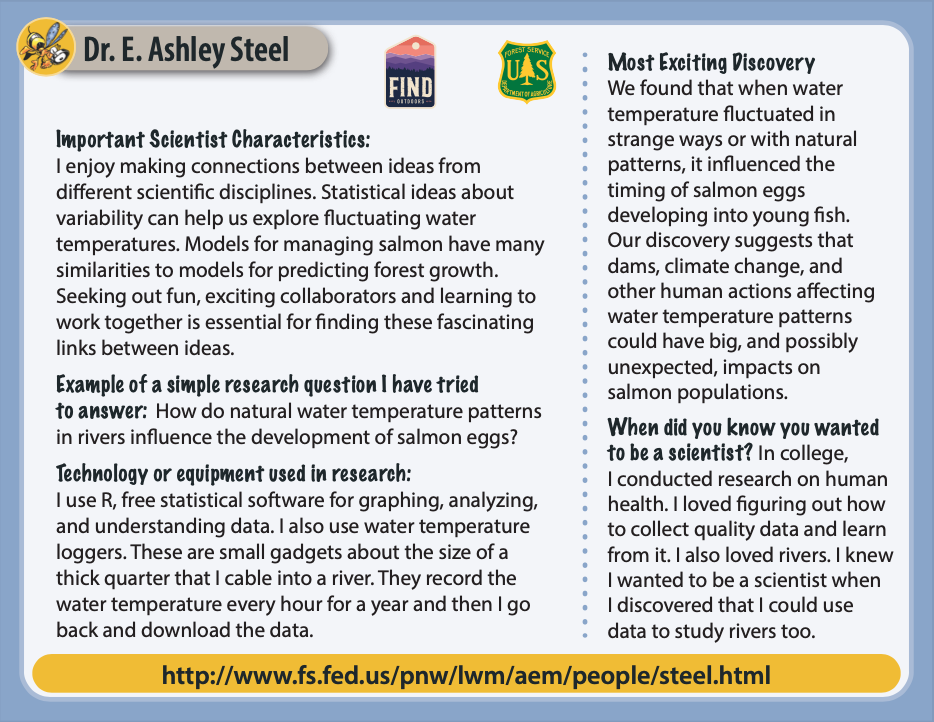
E. Ashley Steel, Quantitative Ecologist
- Ph.D., University of Washington-Seattle
- USDA Forest Service Scientist
- A quantitative ecologist uses mathematical skills and ideas to better understand forests, rivers, oceans, fish, wildlife, climate, and more.
- Ph.D., University of Washington-Seattle
- USDA Forest Service Scientist
- A quantitative ecologist uses mathematical skills and ideas to better understand forests, rivers, oceans, fish, wildlife, climate, and more.
-

 Wildlife
Janice Reid, Wildlife Biologist
- B.S., University of California, Berkeley
- USDA Forest Service Scientist
- A wildlife biologist studies animal populations and the habitats with which animals associate.
- B.S., University of California, Berkeley
- USDA Forest Service Scientist
- A wildlife biologist studies animal populations and the habitats with which animals associate.
-

 MappingWildlife
Jenny Rechel, Wildlife Biologist / Geographer
- Ph.D., University of California
- USDA Forest Service Scientist
- As a wildlife biologist and geographer, I focus on studying the effects of disturbance (fire, post-fire erosion, and drought) on bird populations and habitats in the National Forests in southern California.
- Ph.D., University of California
- USDA Forest Service Scientist
- As a wildlife biologist and geographer, I focus on studying the effects of disturbance (fire, post-fire erosion, and drought) on bird populations and habitats in the National Forests in southern California.

