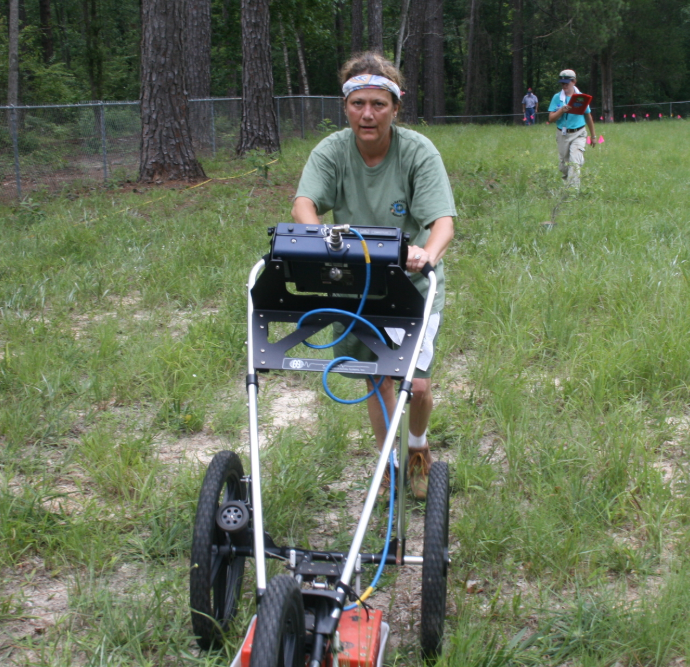
As an archaeologist, I study past human activity (historic and prehistoric) through the scientific recovery and analysis of material culture, like artifacts and ecofacts.
Great people skills along with strong communication skills have helped me with my desire to learn about different aspects of history and prehistory.
How did people live in the past? We know that there were people living on the land long before us. Like us, they had children, made houses, and were involved in wars. These people left behind articles or items, called artifacts, from their activities. Archaeologists are keen to learn about the past from these artifacts, and put the pieces of the puzzle together to reconstruct human history and prehistory of the land.
I use Ground Penetrating Radar (GPR) to find features in the ground. GPR sends a pulse of radar into the ground. It records the length and time of the various signals to tell us if there is an item located in the ground. A series of pulses over a single area is called a scan, and a series of scans can give a picture of what is in the ground. GPR is useful in archaeology because it is non-invasive, and many, if not most, buried features of interest are not that deep in the ground.
I discovered the dirt floor to a Spanish house that had been covered by an Anglo-style house. This discovery made this particular house the oldest in the community.
I was backpacking in the canyon lands of the southwestern United States, and I visited Chaco Canyon, a World Heritage Site. It was there that I first watched archaeologists excavating, which was truly fascinating. I went home, enrolled in university, and I haven’t looked back!