Natural Inquirer - Homepage

Free Science Materials for K-12 Students

  • Bookmarks
  • Account
  • USDA
  • USDA Forest Service logo.
Natural Inquirer - Homepage
  • About
    • About Natural Inquirer
    • Team
    • Partners
    • Press & Past Events
    • Contact Us
  • Resources
    • View All Resources
    • Grade Levels
      • PreK - 2nd Grade
      • Upper Elementary
      • Middle School
      • High School
      • All Grade Levels
    • Resource Types
      • Articles
      • Activities
      • Collector Cards
      • Coloring Pages
      • Videos
      • Lesson Plans
      • Scientists & Collaborators
      • Spotlights
      • Virtual Learning Adventures
      • All Types
    • Resource Topics
      • Wilderness
      • Wildlife
      • Water
      • Active Forest Management
      • Social Science
      • Fire
      • Agriculture
      • Recreation
      • Carbon
      • Insects
      • All Topics
    • Special Collections
      • Artemis Moon Trees
      • Career Exploration
      • Experimental Forests & Ranges
      • Project Learning Tree Connections
      • Globe Connections
      • Designing Your Own Study
      • Smokey Bear
      • Spanish Editions
      • Woodsy Owl
      • Virtual Learning Adventures
      • World's Forests
      • All Special Collections
  • Order Materials
    • View All Products
    • Journals & Monographs
    • Readers
    • Collector Card Packs
    • Coloring Books
  • Educators
    • For Educators
      • Educator Guide
      • Educator Blog
      • Newsletter
    • Classroom Ready Resources
      • Activities
      • Career Exploration
      • Lesson Plans
      • Learning Modules
      • GLOBE Connections
      • Project Learning Tree
    • Get Involved
      • Volunteer Your Classroom
  • Career Exploration
  • Bookmarks
  • Account
  • About
    • About Natural Inquirer
    • Team
    • Partners
    • Press & Past Events
    • Contact
  • Resources
        • View All Resources
        • By Grade
          • PreK - 2nd
          • Upper Elementary
          • Middle School
          • High School
        • By Type
          • Articles
          • Activities
          • Collector Cards
          • Coloring Pages
          • Videos
          • Lesson Plans
          • Learning Modules
          • Journals
          • Monographs
          • Readers
          • Scientists & Collaborators
          • Spotlights
          • Virtual Learning Adventures
          • All Types
        • By Topic
          • Agriculture
          • Active Forest Management
          • Carbon
          • Fire
          • Grasslands
          • Insects
          • Recreation
          • Social Science
          • Water
          • Wilderness
          • Wildlife
          • All Topics
        • Special Collections
          • Artemis Moon Trees
          • Career Exploration
          • Experimental Forests and Ranges
          • GLOBE Connections
          • Project Learning Tree Connections
          • Designing Your Own Study
          • Smokey Bear
          • Spanish Editions
          • Virtual Learning Adventures
          • Woodsy Owl
          • World's Forests
          • All Special Collections
  • Order Materials
        • Download all resources - FREE!

          We will be pausing our services beginning September 25, 2026. We are waiting on a new agreement to be put in a place and are hopeful this pause will be temporary. The website will be available during this time to download and use materials; however, we will not be able to mail hard copies of materials or provide customer support during this time. If you have any questions or concerns about the program, please email SM.FS.RDPublicWeb@usda.gov. We have enjoyed serving you and hope to be able to do so again in the near future.

          View All Products
        • Journals & Monographs

          Journals focus on a group of related articles, while monographs focus on one research article.

          Journals & Monographs
        • Collector Cards

          Learn about possible career opportunities in science!

          View All Card Packs
        • Readers

          For a PreK-2nd grade audience, each Reader focuses on one Forest Service scientist and their research.

          View All Readers
        • Coloring and Activity Books

          Learn more about science through our coloring and outdoor activity books!

          View All Coloring and Activity Books
  • Educators
        • Overview
          • General Educator Guide
          • PreK-2nd Grade Guide
          • Upper Elementary School Guide
          • Middle and High School Guide
          • Non-Formal Education Guide
        • Classroom Ready Resources
          • Career Exploration
          • Learning Modules
          • Lesson Plans
          • Explore All
        • Order Materials
          • View All Free Products
          • Contact Us
        • For Educators
          • Educator Blog
          • Newsletter
          • Project Learning Tree
        • Get Involved
          • Volunteer Your Classroom
  • Career Exploration

Breadcrumb

  • Home
  • Resources
  • One Fish, Two Fish, Red Fish–No Fish? The Current Situation and Possible Future of Aquatic Animals in the United States
different species of fish swimming
Bookmark
Please login to bookmark Close

Please login to bookmark


Lost your password?

No account yet? Register

One Fish, Two Fish, Red Fish–No Fish? The Current Situation and Possible Future of Aquatic Animals in the United States

  • Article
  • Middle School
  • 1 Classroom Period
  • Water
  • Wildlife
  • Aquatic Animals
  • Conservation
  • Endangered Species
  • Freshwater Mussel
  • Prediction
  • Salmon
  • Threatened Species
  • Water Conservation
different species of fish swimming
SHARE
  • Copy Link
  • Facebook
  • X (Twitter)
  • Pinterest
  • Email
  • Google Classroom

The scientists in this study were asked to develop information about the status of and trends in aquatic animal species populations across the United States.

Note: In earlier Natural Inquirer articles like this one, the Discussion section is called "Implications."

One Fish, Two Fish, Red Fish–No Fish? The Current Situation and Possible Future of Aquatic Animals in the United States

Jump To

  • Meet the Scientists
  • Thinking About Science
  • Thinking About the Environment
  • Introduction
  • Methods
  • Results
  • Implications

Meet the Scientists

Andrew Loftus

Andrew Loftus

Natural Resource Consultant

I like being a scientist because it gives me a chance to explore new things and use what I discover to change the way we manage the environment. Read Full Bio
Curtis Flather

Curtis Flather

Ecology

I like being a scientist because it is essentially problem solving, and, in my case, the problems deal with the conservation of wildlife. Working on wildlife conservation problems can be... Read Full Bio

Thinking About Science

Scientists try to solve problems or answer questions by collecting information and doing an analysis of the information they have collected. If they have enough time and money, scientists usually collect their own data. If they do not have enough time or money, or if the kind of data they need are already available, they will analyze data already collected by other scientists.


In this study, the scientists did not have enough time or money to collect their own data. Instead, they used data already collected by other scientists to help them answer their questions. You do the same thing when you write a school paper on a topic not familiar to you. You collect information from other sources, such as the Internet, the library, or encyclopedias. When you collect information to write a paper, you are like the scientists in this study!


Thinking About the Environment

Since the pilgrims landed in Massachusetts in 1620, more than 500 plant and animal species have become extinct in the United States. The U.S. Fish and Wildlife Service is charged with protecting species from extinction. To do this, the U.S. Fish and Wildlife Service studies the populations of animals and plants. When they find a plant or animal species that is in immediate danger of becoming extinct, they classify it as endangered.


When the U.S. Fish and Wildlife Service finds a plant or animal species that is likely to become endangered, it is classified as threatened. Being classified as threatened or endangered provides the plant or animal species with special consideration that protects it from human activities that would further threaten or endanger it.


Introduction

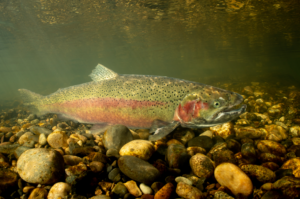
The scientists in this study were asked to develop information about the status of and trends in aquatic animal species populations across the United States. They already knew that there are about 800 freshwater fish species in the United States (figure 1).


A trout in a freshwater stream
Figure 1. Trout are a freshwater aquatic species. Photo courtesy of the USFWS, Ryan Hagerty.


However, the scientists found that there were few measurements already available that would help them to determine the status of and trends in the populations of these 800 freshwater fish and other freshwater aquatic species. The only data they could find were collected in a few separate areas of the country.


In addition, the information was not the same from location to location. Still, the scientists collected information that might show general trends. From these separate pieces of information, the scientists made an informed guess about the status of and potential trends in populations of freshwater aquatic species.


Reflection Section

Please enable JavaScript in your browser to complete this form.

Click submit to view the answers.

Form entries are not stored.

Loading

Methods

The scientists used two types of information. To determine the status of aquatic species populations, they gathered data that had been collected by other scientists. Even though they did not have all of the data that they needed, they made an educated guess about the current status of aquatic animal species populations.


To determine the trends in populations, the scientists studied examples of things that people have done that affected the trends in species. If the things people do increase the populations of aquatic species in a particular stream, river, or lake, this is an example of conservation. Conservation means taking care of the natural environment so that it will be both useful and protected now and in the future.


Reflection Section

Please enable JavaScript in your browser to complete this form.

Click submit to view the answers.

Form entries are not stored.

Loading

Results

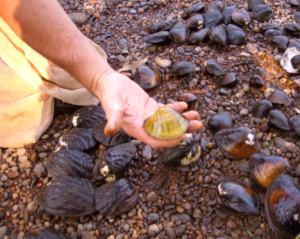
The scientists found that there are more threatened and endangered aquatic species than any other type of animal species, including those that live on land. Of the 297 freshwater mussel species naturally living in North America, 213 are considered threatened, endangered, or of special concern (figure 2). (What percentage is that? Divide 213 by 297 to find out!)


A person holding up a mussel over a bed of rocks.
Figure 2. A Freshwater mussel. Photo courtesy of Dr. Andrew Rypel.


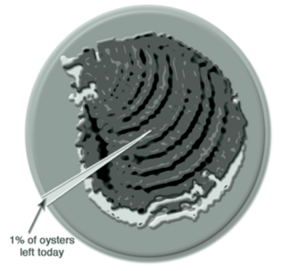
Other species are declining but are not yet considered threatened or endangered. In the Chesapeake Bay, for example, there are 99 percent fewer oysters living there than were living there over 100 years ago (figure 3).


A pie chart showing the decrease in oysters with a picture of an oyster
Figure 3. There are 99 percent fewer oysters living in the Chesapeake Bay now compared to 100 years ago.


In the Pacific Northwest, some types of salmon are threatened or endangered, but the population of salmon as a whole is not considered threatened. In the Northeast, the number of Atlantic salmon is declining. In the Southern Appalachian mountains of Tennessee, the number of miles of streams and rivers where native trout can be found is only about 30 percent of what it used to be.


These are just a few of the examples that the scientists discovered. There are many reasons for the decline in the numbers of fish and other aquatic animals (figure 4). Most of the decline is caused by human activities.


Agriculture—Eroding soil and washing fertilizers into waterways. This is called siltation. Silt is the number one pollutant threatening our Nation’s waters.

Dams—Stopping the free flow of water in a stream or river.

Over-fishing—Taking more fish out of the water than the species can handle to keep their numbers at a healthy level.

Buildings and other human development—Causing erosion and pollution.

Gravel mining—Taking gravel from stream beds for human use.

Water supply—Taking water out of streams and rivers for irrigation of agricultural land and water supply.

Nonnative fish species—Competing with native fish species for food and habitat.

Pollution—Coming from a range of human actions, such as industrial waste products, poor farming practices, runoff from city streets, emissions from cars, etc.

Cattle grazing near streams and lakes—Eroding soil into waterways.

Poor forestry practices—Washing soil from unpaved forest roads into waterways.

Mining—Washing heavy metals into waterways.

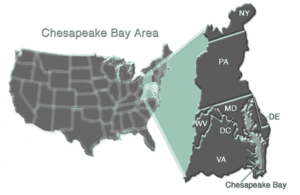
The scientists found that people living in different areas of the country have been doing things to reduce the decline in the populations of aquatic animal species. In some cases, people have been able to improve the quality of streams, rivers, and lakes so that the populations of aquatic animals are actually increasing. For example, a group of people living in the States surrounding the Chesapeake Bay (figure 5) have agreed to work together to clean up the bay. Some of the things they are doing are:


  1. Cleaning up the water and the land surrounding the bay.
  2. Reducing the amount of pollution entering the bay.
  3. Educating citizens about what they can do to protect the bay.
  4. Encouraging citizens to help make decisions about the bay.
  5. Agreeing to continue to work together on solving the problems of the bay.


A map of the U.S. highlighting the Chesapeake Bay area
Figure 5. The States surrounding the Chesapeake Bay.


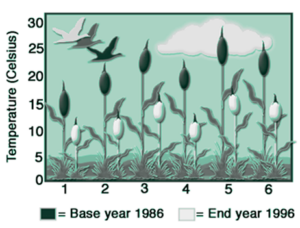
In another example, a group of people from Arizona wanted to improve Canyon Creek for trout. One of the problems was the rising water temperature, caused by the loss of green plants along the stream’s edge. The plants had provided shade for the stream, keeping it cooler. The plants had been killed by cattle that were allowed to graze by the streambank. The people moved the cattle away from the stream and planted native plants along the stream’s edge. Within 8 years, the water temperature dropped from an average of 21.7 °Celsius to 12.3 °Celsius (figure 6). (To determine the temperatures in Fahrenheit, multiply the temperature in Celsius by 9/5 and then add 32.) Because of the cooler water, native trout are once again living and reproducing in Canyon Creek.


A graph showing water temperature changes in six area.
Figure 6. Water temperature changes in six areas of Canyon Creek.


Reflection Section

Please enable JavaScript in your browser to complete this form.

Click submit to view the answers.

Form entries are not stored.

Loading

Implications

Although the scientists were able to determine that the populations of fish and other aquatic animals have been declining across the United States, they do not know exactly what the status of these animals is nationwide.


So that better information is available in the future, the scientists are trying something new. They are working with people from six States to develop a way to share information about fish and other aquatic animals. They have agreed to share the same information, such as water temperature; the number of aquatic species and animals found in streams, rivers, and lakes; and the chemical content of the water. They are using the Internet to share the information.


Using this system, the scientists will know whether populations of aquatic species are continuing to decline, or whether conservation activities are helping aquatic animals to survive and reproduce. The scientists will be able to compare the status of one river with another river. They hope that more States will join the effort. Using this system, one day scientists will know a lot more about the status of and trends in the Nation’s aquatic species.


Reflection Section

Please enable JavaScript in your browser to complete this form.

Click submit to view the answers.

Form entries are not stored.

Loading

From: Loftus, Andrew J. and Flather, Curtis H. 2000. Fish and other aquatic resource trends in the United States: A technical document supporting the 2000 USDA Forest Service RPA Assessment. Gen. Tech. Rep. RMRS-GTR-53. Ft. Collins, CO: USDA Forest Service, Rocky Mountain Research Station. 50 p.

Cover of Natural Inquirer with illustrations of kids studying nature

Part Of

Facts to the Future - Vol. 5 No. 1

Explore Full Journal
SHARE
  • Copy Link
  • Facebook
  • X (Twitter)
  • Pinterest
  • Email
  • Google Classroom
Read Distraction Free Download PDF
  • PDF Preview of One Fish, Two Fish, Red Fish, No Fish FACTivity
    The question you will answer by doing this FACTivity is: What is the status and probable future of a current environmental condition or event? The method you will use to...

    FACTivity – One Fish, Two Fish, Red Fish–No Fish?

    • Activity
    • Middle School
    • 2-3 Classroom Periods
    • Bias
    • Current Events
    • News Reporting
    • Opinion
    • Prediction
    • Reading for Information
    The question you will answer by doing this FACTivity is: What is the status and probable future of a current environmental condition or event? The method you will use to...
    • Explore Activity
    • Download Activity (PDF)
    • Explore Activity
    • Download Activity (PDF)

    Part Of

    One Fish, Two Fish, Red Fish--No Fish? The Current Situation and Possible Future of Aquatic Animals in the United States

  • PDF Preview of One Fish, Two Fish Word Search
    Test your knowledge of freshwater, aquatic species, habitat, and conservation with a word search.

    Word Search – One Fish, Two Fish, Red Fish–No Fish?

    • Activity
    • Middle School
    • Less than 30 minutes
    • Water
    • Aquatic Animals
    • Freshwater
    • Habitat
    • Vocabulary
    Test your knowledge of freshwater, aquatic species, habitat, and conservation with a word search.
    • Explore Activity
    • Download Word Search (PDF)
    • Answer Key (PDF)
    • Explore Activity
    • Download Word Search (PDF)
    • Answer Key (PDF)

    Part Of

    One Fish, Two Fish, Red Fish--No Fish? The Current Situation and Possible Future of Aquatic Animals in the United States

Download PDF

Jump To

  • Education Standards
  • Educator Guide
  • Lesson Plans
  • Education Files

Standards addressed in this Article:

The Next Generation Science Standards (NGSS) are a set of K-12 science education standards emphasizing inquiry-based learning, real-world applications, and integrating engineering practices, aiming to deepen understanding of science while promoting critical thinking and problem-solving skills.
  • ESS3.C-M1
    Human activities have significantly altered the biosphere, sometimes damaging or destroying natural habitats and causing the extinction of other species. But changes to Earth’s environments can have different impacts (negative and positive) for different living things.
  • ESS3.C-M2
    Typically as human populations and per capita consumption of natural resources increase, so do the negative impacts on Earth unless the activities and technologies involved are engineered otherwise.
  • ESS3.D-M1
    Human activities, such as the release of greenhouse gases from burning fossil fuels, are major factors in the current rise in Earth’s mean surface temperature (global warming). Reducing the level of climate change and reducing human vulnerability to whatever climate changes do occur depend on the understanding of climate science, engineering capabilities, and other kinds of knowledge, such as understanding of human behavior, and on applying that knowledge wisely in decisions and activities.
  • LS2.A-M1
    Organisms, and populations of organisms, are dependent on their environmental interactions both with other living things and with nonliving factors.
  • LS2.A-M2
    In any ecosystem, organisms and populations with similar requirements for food, water, oxygen, or other resources may compete with each other for limited resources, access to which consequently constrains their growth and reproduction.
  • LS2.A-M3
    Growth of organisms and population increases are limited by access to resources.
  • LS2.C-M1
    Ecosystems are dynamic in nature; their characteristics can vary over time. Disruptions to any physical or biological component of an ecosystem can lead to shifts in all its populations.
  • LS2.C-M2
    Biodiversity describes the variety of species found in Earth’s terrestrial and oceanic ecosystems. The completeness or integrity of an ecosystem’s biodiversity is often used as a measure of its health.
The Common Core Standards are educational benchmarks in the United States that outline clear expectations for what students should know and be able to do in English language arts and mathematics from kindergarten through 12th grade, aiming to ensure consistency and coherence in education nationwide.
  • Cite specific textual evidence to support analysis of science and technical texts.
  • By the end of grade 8, read and comprehend science/technical texts in the grades 6-8 text complexity band independently and proficiently.
  • Determine the central ideas or conclusions of a text; provide an accurate summary of the text distinct from prior knowledge or opinions.
  • Follow precisely a multistep procedure when carrying out experiments, taking measurements, or performing technical tasks.
  • Determine the meaning of symbols, key terms, and other domain-specific words and phrases as they are used in a specific scientific or technical context relevant to grades 6-8 texts and topics.
  • Analyze the structure an author uses to organize a text, including how the major sections contribute to the whole and to an understanding of the topic.
  • Analyze the author's purpose in providing an explanation, describing a procedure, or discussing an experiment in a text.
  • Integrate quantitative or technical information expressed in words in a text with a version of that information expressed visually (e.g., in a flowchart, diagram, model, graph, or table).
  • Distinguish among facts, reasoned judgment based on research findings, and speculation in a text.
  • Compare and contrast the information gained from experiments, simulations, video, or multimedia sources with that gained from reading a text on the same topic.
Social Studies Standards are educational guidelines outlining the essential knowledge, skills, and concepts students should learn in subjects such as history, geography, civics, and economics, aiming to provide a comprehensive understanding of societal structures, historical events, and global perspectives.
  • People, Places, and Environments
  • Science, Technology, and Society
  • Time, Continuity, and Change

What Is a Natural Inquirer Journal?

Three Natural Inquirer journal covers with NI bee


A Natural Inquirer journal is a collection of 4-8 articles on a related science topic. Journals are written for a middle school audience, but they can also be adapted for both high school students and advanced upper elementary students. Some journals are particularly suited to high school students; you can find our grade level recommendations in the tags on the product page or by filtering journals by grade level.

Journals include:

  • Four to eight articles based on published, peer-reviewed research papers; the articles keep the research paper format (see more below) but are written in language students can understand.
  • A FACTivity for each article, which is an activity to complete after reading the article. The FACTivity helps reinforce major science concepts from the article. These activities are designed to be easy to implement, with few material requirements and options for adapting them for your audience or available resources. Some articles in a journal may have two FACTivities.
  • A short “Welcome to the journal” article about key background information and science concepts that unify the articles included in the journal
  • A glossary of new terms for each article and the introductory materials.
  • A list of related Natural Inquirer publications for each article as well as outside references.
  • Standards correlations, including Next Generation Science Standards, addressed in the articles and the FACTivities.

Journals may also include additional essays (called spotlights), other activities (like crossword puzzles or vocabulary challenges), and more.


A screenshot of the article resource tile for "A Flame Changer" showing the three different format option buttons.

Reading Modes

Journals are available in three different formats:

  • Hard copies can be ordered from the website and shipped, all free of charge.
  • PDF versions of the printed journal can be downloaded free on the website. The PDF version directly replicates the content and layout of the printed version. You can also download individual articles as pdfs.
  • The “Read Distraction Free” option allows the individual articles to open in their own window, without the rest of the website being visible. These articles can be found under the “Articles” tab. This version allows readers to scroll to particular sections of the article using the sidebar menu on the left side of the screen. This version also has interactive Reflection Sections and Number Crunches. Students can enter their answers, submit them, and then receive the correct answers to double-check their work. Submitted answers are not saved on the website and will disappear once the window is closed.

What's in a Natural Inquirer Article?

Here, we'll go into more detail about the parts of a Natural Inquirer article and give you some ideas about how they can be used.
  1. Meet the Scientists

    This section introduces the scientists (and others) who worked on the study. In their own words, they each share a memorable science experience, a favorite research project, or something they learned during the course of their education or research.

    Use this section to:

    • Introduce kids to the variety of people who work in science
    • Introduce kids to the variety of scientific fields and give brief descriptions of science-related jobs
    • Explore ways that people interact with science every day

    Next Generation Science Standards (NGSS) applications:

    • Science and Engineering Practices
    • Crosscutting Concepts: Influence of Science, Engineering, and Technology on Society and the Natural World

    Note that specific standards for this particular journal are linked on this educator guide tab.

    Other resources:

    Many of the scientists and engineers featured in this section are also featured on our collector cards. Learn more about their work, how they got interested in their fields, and interesting projects they worked on. Cards can be printed as posters, too.

    A sample Meet the Scientists page, showing four different scientists
  2. Thinking About Science

    This section briefly describes a concept about science or scientific research. This overview can touch on topics like

    • study type (longitudinal study, quantitative vs. qualitative data),
    • behaviors of scientists (conducting literature reviews, collaborating with other specialists, replicating earlier studies),
    • the practice of science (the scientific method, engineering design, data collection, randomization, controls and variables),
    • or other aspects of science (bias, correlation vs. causation).

    Use this section to:

    • Reinforce steps in the scientific method and the process of science
    • Encourage students to think about the practice of science and what it can and cannot tell us
    • Consider the many types of scientific study and what information each type can provide

    Next Generation Science Standards applications:

    • Science and Engineering Practices
    • Life Science Disciplinary Core Ideas (depending on topic)
    • Most Crosscutting Concepts (depending on topic)

    Note that specific standards for this particular journal are linked on this educator guide tab.

    Other resources:

    You can use key words to search for other or related scientific topics on our website (e.g. “longitudinal study,” “bias,” or “sampling”).

    A sample Thinking About Science page from a recent monograph
  3. Thinking About the Environment

    This section provides a brief overview of a topic or concept in environmental/life science. The topic or concept is directly related to the research study that follows. Examples of topics include the carbon cycle, the water cycle, habitat fragmentation, phenology, biodiversity, and ecosystem services.

    Use this section to:

    • Provide important background information to help students understand the research study
    • Serve as a quick reference during reading or class instruction
    • Connect the research article with other activities or media on the same topic

    Next Generation Science Standards applications:

    • Life Science and some Earth Science Disciplinary Core Ideas (depending on topic)
    • Most Crosscutting Concepts (depending on topic)

    Note that specific standards for this particular journal are linked on this educator guide tab.

    Other resources:

    You can use key words to search for more resources on life or earth science topics on our website (e.g. “habitat,” “carbon,” or “genetics”).

    A sample "Thinking About the Environment" section from a recent monograph
  4. Introduction

    This section begins the scientific article format. Much like the published, peer-reviewed study this article is based on, the introduction provides background information for the study – what is currently known and what remains unknown. The introduction culminates in the question(s) the study hopes to answer.

    The introduction is also the first section with a Reflection Section. This section includes two or three questions to help kids reflect on what they’ve just learned in the Introduction. If they are using the online distraction-free reading mode, they can answer these questions directly on the website.

    Use this section to:

    • Review important background information that kids need to understand the study
    • Connect the study to the concepts addressed in the Thinking About Science and Thinking About the Environment sections
    • Understand research questions and hypotheses, including generating their own hypotheses given what they already know

    Next Generation Science Standards applications:

    • Life Science and some Earth Science Disciplinary Core Ideas (depending on topic)
    • Most Crosscutting Concepts (depending on topic)

    Note that specific standards for this particular journal are linked on this educator guide tab.

    Other resources:

    Use one of the guided reading lesson plans to help kids follow the format of a scientific paper.

    A sample introduction page from "Hidden in Plain Sight"
  5. Methods

    This section is the nuts and bolts of the study design – the who, what, when, where, why, and how of the research. Contained within the Methods section are usually maps of the study location or the set-up of study plots, as well as details about what data was collected and how.

    The Methods section also ends with a Reflection Section – two or three questions to help students think through what they just read. These questions are interactive on the distraction-free reading mode.

    Use this section to:

    • Show students how experiments and studies are designed and carried out
    • Explore sampling methods and randomization
    • Introduce various data collection tools (e.g. camera traps, surveys, insect collection tools, weather stations, etc.)
    • Explain bias and how studies are designed to remove bias
    • Help students gain experience with map reading

    Next Generation Science Standards applications:

    • Life Science and some Earth Science Disciplinary Core Ideas (depending on topic)
    • Most Crosscutting Concepts (depending on topic)

    Note that specific standards for this particular journal are linked on this educator guide tab.

    Other resources:

    Many Methods and Findings sections contain Number Crunches, which are simple math exercises designed to help students interact with the data from the study.

    A sample methods section of a monograph article showing a map
  6. Findings

    This section summarizes the data collected during the study. The Findings section usually includes data tables or graphs and highlights the significant data points from the study. This section often mentions statistical analysis or the use of computer programs to model or analyze the data, though these methods are only discussed generally.

    The Findings section also ends with a Reflection Section – two or three questions to help students think through what they just read. These questions are interactive on the distraction-free reading mode.

    Use this section to:

    • Have students practice reading and interpreting graphs and tables
    • Compare results between variables and controls
    • Explain the concept of statistical significance
    • Discuss how no data or negative results still provide valuable information

    Next Generation Science Standards applications:

    • Life Science and some Earth Science Disciplinary Core Ideas (depending on topic)
    • Most Crosscutting Concepts (depending on topic)

    Note that specific standards for this particular journal are linked on this educator guide tab.

    Other resources:

    Search the website for “map” or “graph” to find activities where students can practice making and reading maps and graphs.

    The beginning of a Findings section featuring a large data table
  7. Discussion

    This section concludes each article. In it, we summarize the main findings of the scientists’ study. Additionally, we present the scientists’ ideas about the limitations of their study, the big-picture impacts of their research, and the scientists’ plans for future study or action.

    The Discussion section ends with a Reflection Section – two or three questions to help students think through what they just read, especially general take-aways from the study. These questions are interactive on the distraction-free reading mode.

    Use this section to:

    • Discuss what conclusions can and cannot be drawn from the available data
    • Explain the difference between correlation and causation
    • Explore study limitations and opportunities for further study
    • Brainstorm ways the study findings could be applied to real-world situations

    Next Generation Science Standards applications:

    • Life Science and some Earth Science Disciplinary Core Ideas (depending on topic)
    • Most Crosscutting Concepts (depending on topic)

    Note that specific standards for this particular journal are linked on this educator guide tab.

    Other resources:

    Use the “Designing Your Own Study” resource page for videos of scientists discussing their own research studies. The page also includes educator resources to help students plan their own scientific studies.

    The beginning of the conclusion of "Hidden in Plain Sight"

Additional Resources on the Website

A screenshot of the product tabs for an NI monographOn the website, we pair each journal with a variety of other resources, as well. Use the tabs on the product page to browse through the following:

  • Related activities, including the FACTivity for each article
  • An “About” essay that gives some larger context for the research the scientists conducted or more information about the science topic from the journal
  • A glossary of all boldfaced terms from the journal
  • A “Scientists and Collaborators” page that lists the people involved in the studies in the journal; click on a researcher to reach their bio page and see what other articles they might be featured in
  • A “Related Content” page that lists both Natural Inquirer resources about similar topics and also outside reference materials

Article Selection and Review

Natural Inquirer partners with the USDA Forest Service, so we source research studies by Forest Service scientists that have been peer-reviewed and published in reputable journals. Some of our articles have also been created in collaboration with scientists from other Federal agencies, such as U.S. Geological Survey and the United Nations Food and Agriculture Organization, universities, and other non-profits.

All journal articles are reviewed by scientists who conducted the original research study to verify scientific accuracy. Journals are also reviewed by student editorial review boards of middle or high school students before publication. Additionally, all journals are reviewed by the Forest Service and the U.S. Department of Agriculture before publication.

A screenshot of the citation for "Lights, Camera, Tracks"Every journal article includes a citation of its source study. Many educators pair the original research paper with our article to help more advanced students learn how to read formal research papers. The journal article then serves as adapted primary literature, bridging the two articles.

Lessons

  • PDF Preview of Urban Forest Lesson Plan
    In this lesson plan, students will assess the biological diversity of trees on their school grounds or another designated area. Students will be able to: observe identify, measure, transform, and...

    Lesson Plan – Urban Forests

    • Lesson Plan
    • High School
    • Middle School
    • 5 Classroom Periods
    • Citizen Science
    • Biodiversity
    • Math
    • Observation
    • Sampling
    • Tree Identification
    • Trees
    In this lesson plan, students will assess the biological diversity of trees on their school grounds or another designated area. Students will be able to: observe identify, measure, transform, and...
    • Explore Lesson Plan
    • Download Lesson Plan (PDF)
    • Explore Lesson Plan
    • Download Lesson Plan (PDF)

    Part Of

    Urban Forest - Vol. 6 No. 1

  • PDF preview of the first page of Forest Poems Lesson Plan
    The purpose of this lesson plan is to give students a chance to reflect on their reading and create poems to express what they have learned. The lesson plan is...

    Lesson Plan – Forest Poems

    • Lesson Plan
    • Middle School
    • Upper Elementary
    • 1 Classroom Period
    • Active Forest Management
    • Agriculture
    • Carbon
    • Citizen Science
    • Engineering and Forest Products
    • Fire
    • Insects
    • Pollinators
    • Pollution
    • Recreation
    • Social Science
    • Water
    • Wilderness
    • Wildlife
    • Creative Writing
    • Haiku
    • Nature
    • Reflection
    The purpose of this lesson plan is to give students a chance to reflect on their reading and create poems to express what they have learned. The lesson plan is...
    • Explore Lesson Plan
    • Download Lesson Plan (PDF)
    • Explore Lesson Plan
    • Download Lesson Plan (PDF)

    Part Of

    Wildland Fire 2 - Vol. 13 No. 1

  • PDF Preview of THIEVES Chart Lesson Plan
    Give each student or group a copy of the THIEVES chart reproduced at the end of the lesson plan PDF. You may either write the questions on the board, or...

    Lesson Plan – THIEVES Chart Guided Reading

    • Lesson Plan
    • Middle School
    • 1 Classroom Period
    • Active Forest Management
    • Agriculture
    • Carbon
    • Citizen Science
    • Engineering and Forest Products
    • Fire
    • Insects
    • Pollinators
    • Pollution
    • Recreation
    • Social Science
    • Water
    • Wilderness
    • Wildlife
    • Graphic Organizer
    • Guided reading
    • Reading for Information
    Give each student or group a copy of the THIEVES chart reproduced at the end of the lesson plan PDF. You may either write the questions on the board, or...
    • Explore Lesson Plan
    • Download Lesson Plan (PDF)
    • Explore Lesson Plan
    • Download Lesson Plan (PDF)

    Part Of

    Natural Inquirer - Vol. 14 No. 1

Education Files

Glossary

View All Glossary
  • analysis

    (ǝ na lǝ sǝs): An examination of a whole to discover its elements and their relations.

  • aquatic

    (ǝ kwä tik): Growing or living in or often found in water.

  • assumption

    (ǝ sǝm(p) shǝn): A fact or statement taken for granted (that it is true).

  • classify

    (kla sǝ fī): To arrange in a group, set, or kind that shares common attributes.

  • conservation

    (kän(t) sər vā shən): A careful preservation and protection of something, especially planned management of a natural resource to prevent exploitation, destruction, or neglect.

  • data

    (dā tǝ or da tǝ): Factual information (such as measurements or statistics) used as a basis for reasoning, discussion, or calculation.

  • emission

    (ē mi shǝn): Something emitted or discharged, usually into the air.

  • erode

    (i rōd): To wear away by the action of water, wind, or glacial ice.

  • extinct

    (ik stiŋ(k)t or ek stiŋ(k)t): No longer existing.

  • freshwater

    (fresh wȯ tǝr): (adjective) living in or taken from fresh water; (noun) water that is not salty.

  • habitat

    (ha bә tat): The place or environment where a plant or animal naturally or normally lives and grows.

  • manage

    (ma nij): (1) To look after and make decisions about; (2) to treat with care.

  • native

    (nā tiv): Living or growing naturally in a particular region.

  • population

    (pä pyǝ lā shǝn): The total of individuals occupying an area.

  • species

    (spē sēz or spē shēz): A category of living things that ranks below a genus, is made up of related individuals able to produce fertile offspring, and is identified by a two-part scientific name.

  • status

    (stat ǝs or stāt ǝs): A particular state or condition.

  • trend

    (trend): The general movement over time of a statistically detectable change.

  • wildlife

    (wī(e)l(d) līf): Living things and especially mammals, birds, and fishes that are neither human nor domesticated.

  • Dr. Curtis Flather

    Curtis Flather

    Ecology

    I like being a scientist because it is essentially problem solving, and, in my case, the problems deal with the conservation of wildlife. Working on wildlife conservation problems can be...
    View Profile
  • Mr. Andy Loftus

    Andrew Loftus

    Natural Resource Consultant

    I like being a scientist because it gives me a chance to explore new things and use what I discover to change the way we manage the environment.
    View Profile
Back to Top
  • Natural Inquirer - Homepage
  • USDA
  • USDA Forest Service logo.

The Natural Inquirer program produces a variety of science education materials for PreK through grade 12. Natural Inquirer products are produced by the USDA Forest Service and other cooperators and partners.

Please enable JavaScript in your browser to complete this form.
* denotes mandatory fields
Loading
  • Facebook
  • Pinterest
  • X, formerly Twitter
  • YouTube
  • About Natural Inquirer
  • Team
  • Partners
  • Press & Past Events
  • Contact Us
  • Accessibility Policy
  • Privacy Policy
  • Shipping Policy
© 2026 - Natural Inquirer | Website Credit