


NSI: Hydrologist Page
SHARE
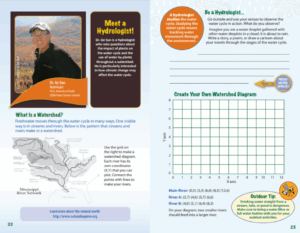
Meet Dr. Ge Sun - a hydrologist who asks questions about the impact of plants on the water cycle and the use of water by plants throughout a watershed. He is particularly interested in how climate change may affect the water cycle. Complete the activity to try out being a hydrologist!

SHARE
Standards addressed in this Activity:
The Next Generation Science Standards (NGSS) are a set of K-12 science education standards emphasizing inquiry-based learning, real-world applications, and integrating engineering practices, aiming to deepen understanding of science while promoting critical thinking and problem-solving skills.
-
4-ESS2-2
Analyze and interpret data from maps to describe patterns of Earths features.
-
5-ESS2-1
Develop a model using an example to describe ways the geosphere, biosphere, hydrosphere, and/or atmosphere interact.
The Common Core Standards are educational benchmarks in the United States that outline clear expectations for what students should know and be able to do in English language arts and mathematics from kindergarten through 12th grade, aiming to ensure consistency and coherence in education nationwide.
-
Use a pair of perpendicular number lines, called axes, to define a coordinate system, with the intersection of the lines (the origin) arranged to coincide with the 0 on each line and a given point in the plane located by using an ordered pair of numbers, called its coordinates. Understand that the first number indicates how far to travel from the origin in the direction of one axis, and the second number indicates how far to travel in the direction of the second axis, with the convention that the names of the two axes and the coordinates correspond (e.g., x-axis and x-coordinate, y-axis and y-coordinate).
-
Represent real world and mathematical problems by graphing points in the first quadrant of the coordinate plane, and interpret coordinate values of points in the context of the situation.
Social Studies Standards are educational guidelines outlining the essential knowledge, skills, and concepts students should learn in subjects such as history, geography, civics, and economics, aiming to provide a comprehensive understanding of societal structures, historical events, and global perspectives.
-
People, Places, and Environments
-
Science, Technology, and Society
-

Ge Sun
My favorite science experience is getting my ideas and study results published in scientific journals. That way, they will be recorded and hopefully used by future generations to understand their...View Profile
Related Resources from the Natural Inquirer
-
 NSI: Nature Science Investigator (NSI) is a self-guided activity book for children ages 8-14. The booklet enables each student to become the scientist! Eleven Forest Service scientists are highlighted. Students...
NSI: Nature Science Investigator
NSI: Nature Science Investigator (NSI) is a self-guided activity book for children ages 8-14. The booklet enables each student to become the scientist! Eleven Forest Service scientists are highlighted. Students... -
 Meet Dr. Ken Cordell – a social scientist who asks questions about how people value and use our natural lands. He looks at trends in outdoor activity participation, such as...
NSI: Social Scientist Page
Meet Dr. Ken Cordell – a social scientist who asks questions about how people value and use our natural lands. He looks at trends in outdoor activity participation, such as... -
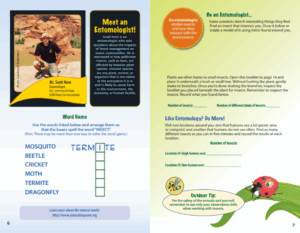 Meet Scott Horn – an entomologist who asks questions about the impacts of forest management on insect communities. He is interested in how pollinator insects, such as bees, are affected...
NSI: Entomologist Page
Meet Scott Horn – an entomologist who asks questions about the impacts of forest management on insect communities. He is interested in how pollinator insects, such as bees, are affected... -
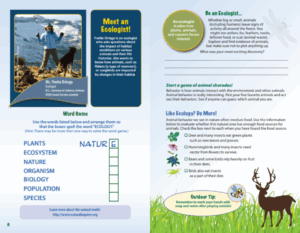 Meet Yvette Ortega – an ecologist who asks questions about the impact of habitat conditions on various animals and their life histories. She wants to know how animals, such as...
NSI: Ecologist Page
Meet Yvette Ortega – an ecologist who asks questions about the impact of habitat conditions on various animals and their life histories. She wants to know how animals, such as... -
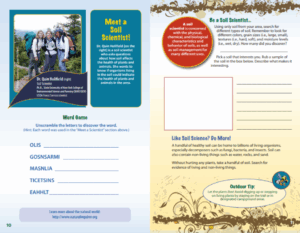 Meet Dr. Quin Holifield – a soil scientist who asks questions about how soil affects the health of plants and animals. She wants to know if organisms living in the...
NSI: Soil Scientist Page
Meet Dr. Quin Holifield – a soil scientist who asks questions about how soil affects the health of plants and animals. She wants to know if organisms living in the... -
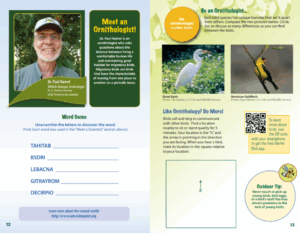 Meet Dr. Paul Hamel – an ornithologist who asks questions about the balance between living a comfortable human life and maintaining good habitat for migratory birds. Migratory birds are birds...
NSI: Wildlife Biologist and Ornithologist Page
Meet Dr. Paul Hamel – an ornithologist who asks questions about the balance between living a comfortable human life and maintaining good habitat for migratory birds. Migratory birds are birds... -
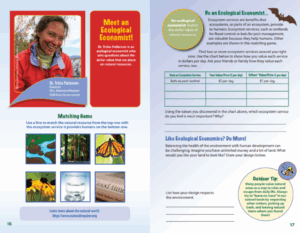 Meet Dr. Trista Patterson – an ecological economist who asks questions about the dollar value that we place on natural resources. Complete the activity to try out being an economist!
NSI: Economist Page
Meet Dr. Trista Patterson – an ecological economist who asks questions about the dollar value that we place on natural resources. Complete the activity to try out being an economist! -
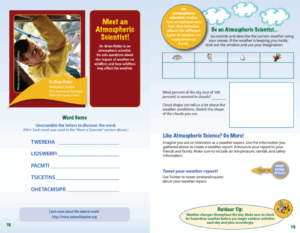 Meet Dr. Brian Potter – an atmospheric scientist. He asks questions about the impact of weather on wildfires and how wildfires may affect the weather. Complete the activity to try...
NSI: Atmospheric Scientist Page
Meet Dr. Brian Potter – an atmospheric scientist. He asks questions about the impact of weather on wildfires and how wildfires may affect the weather. Complete the activity to try... -
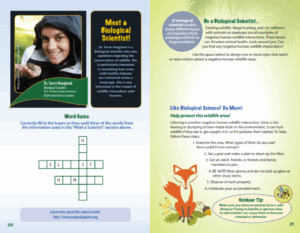 Meet Dr. Serra Hoagland – a biological scientist who asks questions regarding the conservation of wildlife. She is particularly interested in examining how areas with healthy habitats are connected across...
NSI: Biological Scientist Page
Meet Dr. Serra Hoagland – a biological scientist who asks questions regarding the conservation of wildlife. She is particularly interested in examining how areas with healthy habitats are connected across... -
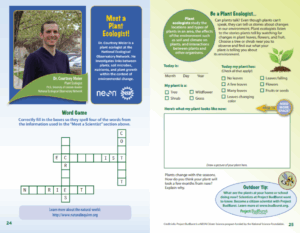 Meet Dr. Courtney Meier – a plant ecologist at the National Ecological Observatory Network. He investigates links between plants, soil microbes, nutrients, and plant growth within the context of environmental...
NSI: Plant Ecologist Page
Meet Dr. Courtney Meier – a plant ecologist at the National Ecological Observatory Network. He investigates links between plants, soil microbes, nutrients, and plant growth within the context of environmental... -
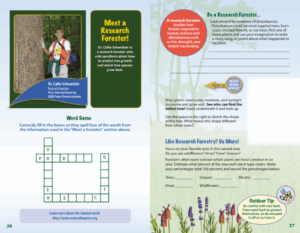 Meet Dr. Callie Schweitzer – a research forester who asks questions about how to predict tree growth and which tree species grow best. Complete the activity to try out being a...
NSI: Research Forester Page
Meet Dr. Callie Schweitzer – a research forester who asks questions about how to predict tree growth and which tree species grow best. Complete the activity to try out being a...