Natural Inquirer - Homepage

Free Science Materials for K-12 Students

  • Bookmarks
  • Account
  • USDA
  • USDA Forest Service logo.
Natural Inquirer - Homepage
  • About
    • About Natural Inquirer
    • Team
    • Partners
    • Press & Past Events
    • Contact Us
  • Resources
    • View All Resources
    • Grade Levels
      • PreK - 2nd Grade
      • Upper Elementary
      • Middle School
      • High School
      • All Grade Levels
    • Resource Types
      • Articles
      • Activities
      • Collector Cards
      • Coloring Pages
      • Videos
      • Lesson Plans
      • Scientists & Collaborators
      • Spotlights
      • Virtual Learning Adventures
      • All Types
    • Resource Topics
      • Wilderness
      • Wildlife
      • Water
      • Active Forest Management
      • Social Science
      • Fire
      • Agriculture
      • Recreation
      • Carbon
      • Insects
      • All Topics
    • Special Collections
      • Artemis Moon Trees
      • Career Exploration
      • Experimental Forests & Ranges
      • Project Learning Tree Connections
      • Globe Connections
      • Designing Your Own Study
      • Smokey Bear
      • Spanish Editions
      • Woodsy Owl
      • Virtual Learning Adventures
      • World's Forests
      • All Special Collections
  • Order Materials
    • View All Products
    • Journals & Monographs
    • Readers
    • Collector Card Packs
    • Coloring Books
  • Educators
    • For Educators
      • Educator Guide
      • Educator Blog
      • Newsletter
    • Classroom Ready Resources
      • Activities
      • Career Exploration
      • Lesson Plans
      • Learning Modules
      • GLOBE Connections
      • Project Learning Tree
    • Get Involved
      • Volunteer Your Classroom
  • Career Exploration
  • Bookmarks
  • Account
  • About
    • About Natural Inquirer
    • Team
    • Partners
    • Press & Past Events
    • Contact
  • Resources
        • View All Resources
        • By Grade
          • PreK - 2nd
          • Upper Elementary
          • Middle School
          • High School
        • By Type
          • Articles
          • Activities
          • Collector Cards
          • Coloring Pages
          • Videos
          • Lesson Plans
          • Learning Modules
          • Journals
          • Monographs
          • Readers
          • Scientists & Collaborators
          • Spotlights
          • Virtual Learning Adventures
          • All Types
        • By Topic
          • Agriculture
          • Active Forest Management
          • Carbon
          • Fire
          • Grasslands
          • Insects
          • Recreation
          • Social Science
          • Water
          • Wilderness
          • Wildlife
          • All Topics
        • Special Collections
          • Artemis Moon Trees
          • Career Exploration
          • Experimental Forests and Ranges
          • GLOBE Connections
          • Project Learning Tree Connections
          • Designing Your Own Study
          • Smokey Bear
          • Spanish Editions
          • Virtual Learning Adventures
          • Woodsy Owl
          • World's Forests
          • All Special Collections
  • Order Materials
        • Download all resources - FREE!

          We will be pausing our services beginning September 25, 2026. We are waiting on a new agreement to be put in a place and are hopeful this pause will be temporary. The website will be available during this time to download and use materials; however, we will not be able to mail hard copies of materials or provide customer support during this time. If you have any questions or concerns about the program, please email SM.FS.RDPublicWeb@usda.gov. We have enjoyed serving you and hope to be able to do so again in the near future.

          View All Products
        • Journals & Monographs

          Journals focus on a group of related articles, while monographs focus on one research article.

          Journals & Monographs
        • Collector Cards

          Learn about possible career opportunities in science!

          View All Card Packs
        • Readers

          For a PreK-2nd grade audience, each Reader focuses on one Forest Service scientist and their research.

          View All Readers
        • Coloring and Activity Books

          Learn more about science through our coloring and outdoor activity books!

          View All Coloring and Activity Books
  • Educators
        • Overview
          • General Educator Guide
          • PreK-2nd Grade Guide
          • Upper Elementary School Guide
          • Middle and High School Guide
          • Non-Formal Education Guide
        • Classroom Ready Resources
          • Career Exploration
          • Learning Modules
          • Lesson Plans
          • Explore All
        • Order Materials
          • View All Free Products
          • Contact Us
        • For Educators
          • Educator Blog
          • Newsletter
          • Project Learning Tree
        • Get Involved
          • Volunteer Your Classroom
  • Career Exploration

Breadcrumb

  • Home
  • Resources
  • It’s a Gas! The Exchange of Gases Between the Soil and the Atmosphere
The cover of "It's a Gas: The Exchange of Gases Between the Soil and the Atmosphere" featuring a black and white drawing of a person looking at a cow through a magnifying glass.
Bookmark
Please login to bookmark Close

Please login to bookmark


Lost your password?

No account yet? Register

It’s a Gas! The Exchange of Gases Between the Soil and the Atmosphere

  • Article
  • Middle School
  • 1 Classroom Period
  • Active Forest Management
  • Agriculture
  • Atmosphere
  • Cattle
  • Deforestation
  • Forest Succession
  • Green House Effect
  • Nitrogen Cycle
  • Pasture
  • Soil
The cover of "It's a Gas: The Exchange of Gases Between the Soil and the Atmosphere" featuring a black and white drawing of a person looking at a cow through a magnifying glass.
SHARE
  • Copy Link
  • Facebook
  • X (Twitter)
  • Pinterest
  • Email
  • Google Classroom

Tropical forests are sometimes cut down so that humans can use the trees for wood and other products. Then, the cleared land is made into a pasture so that cattle can be raised for human consumption. When forest land becomes pasture, the soil changes. The soil changes again once the land is abandoned. The scientists wanted to know if new forests in pastures released greenhouse gases.

Note: In earlier Natural Inquirer articles like this one, the Discussion section is called "Implications."

It’s a Gas! The Exchange of Gases Between the Soil and the Atmosphere

Jump To

  • Meet the Scientist
  • Thinking About Science
  • Thinking About The Environment
  • Introduction
  • Method
  • Results
  • Implications

Meet the Scientist

Michael Keller

Michael Keller

Physical Scientist

I like being a scientist because I get to follow my natural curiosity to learn how the Earth system works. My work is split between the field, the office, and... Read Full Bio

Thinking About Science

Chemistry is the science of the building blocks of all matter. Atoms are the most basic building block. Molecules are combinations of two or more atoms of the same chemical element. All matter is built from over 100 chemical elements. Examples of elements are nitrogen, hydrogen, oxygen, and carbon. Compounds are made up of two or more elements. To make it easier to imagine, think about the alphabet. Atoms are like different letters. There could be “A” atoms, “B” atoms, and “C” atoms, for example. Elements are like a single letter, such as A, I, or T. Molecules are like strings of the same letter (or element), such as BBB or MMMM. Compounds are like words, which are made from different letters (or elements). When elements interact and become compounds, their structure changes. Elements can form an almost limitless number of compounds, just as letters can form an almost limitless number of words. These compounds can be solid, liquid, or gas. Some scientists study the structure and behavior of gaseous compounds. In this study, the scientists were interested in studying the gaseous compounds that go into the atmosphere as greenhouse gases.


Thinking About The Environment

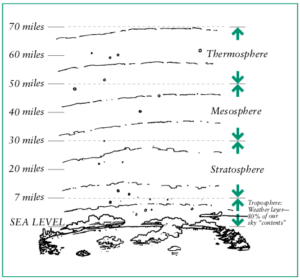
The greenhouse effect is caused by certain gases that act like glass in a greenhouse. They reflect heat in the atmosphere back down to earth (Figure 1). The amount of heat trapped in the atmosphere can vary, depending on the type of gas and how long it stays in the atmosphere. The major greenhouse gases are water vapor, carbon dioxide, methane, nitrous oxide, and chlorofluorocarbons, also called CFCs. We need a certain level of greenhouse gases to maintain a livable climate on Earth. If we had too small an amount of greenhouse gases, the Earth’s climate would get too cold. If we get too great an amount of greenhouse gases, the Earth’s climate will get too warm. Human activities, such as burning fossil fuels like petroleum, can create greenhouse gases. The scientists in this study looked at greenhouse gases from another perspective. They looked at how human activities have enabled soil bacteria to increase the amount of nitrous oxide in the atmosphere.


A graphic of the Earth's atmosphere. Shows depth of troposphere, stratosphere, mesosphere, and thermosphere
Figure 1. The Earth’s atmosphere. The troposphere is the section of our atmosphere reaching from sea level up to 7 miles. Most clouds are contained within the troposphere. When you fly somewhere in a jet, you are flying through the middle and upper portions of our troposphere.


Introduction

Tropical forests are sometimes cut down so that humans can use the trees for wood and other products. Then, the cleared land is made into a pasture so that cattle can be raised for human consumption. When forest land becomes pasture, the soil changes. It becomes more compacted and less porous. (Can you think of why this might happen? Think about the size and weight of cattle.) Previous research had shown that pasture soils release more greenhouse gases than forested land. Sometimes pastures are abandoned after a while. This is often because the soil can no longer produce enough plants to support the cattle. When pastures are abandoned, the forest begins to grow again. No one knew whether soils from these young forests would begin to release less greenhouse gases as the forest grew again. That is the question the scientists wanted to answer.


Reflection Section

Please enable JavaScript in your browser to complete this form.

Click submit to view the answers.

Form entries are not stored.

Loading

Thinking About Ecology

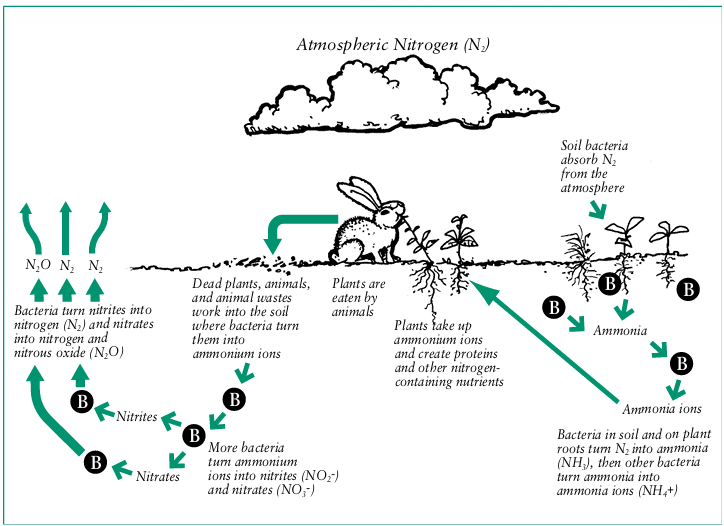
Often, scientists study one particular event or object. While such specialization helps scientists to understand a lot about that one event or object, it does not always help them to understand how that event or object relates to other events or objects. Ecologists are scientists who study how living things relate to each other and to nonliving things. In this study, the ecologists were studying the nitrogen cycle (Figure 2). The nitrogen cycle explains the relationship of the element nitrogen with other elements, and with plants, animals, and bacteria. Bacteria are important in the cycle, because they convert nitrogen from the atmosphere into forms that plants can use such as nitrates and ammonia. These compounds are used by plants to make other compounds such as protein. Animals who eat plants can use the protein from the plants. Bacteria living in soil convert animal wastes and dead material from plants back into nitrogen compounds. The nitrogen is released back to the atmosphere, and the cycle begins again. This is an example of how life depends on relationships between living and nonliving things. What are some examples of how your life depends on living and nonliving things?

A graphic of the nitrogen cycle

Method

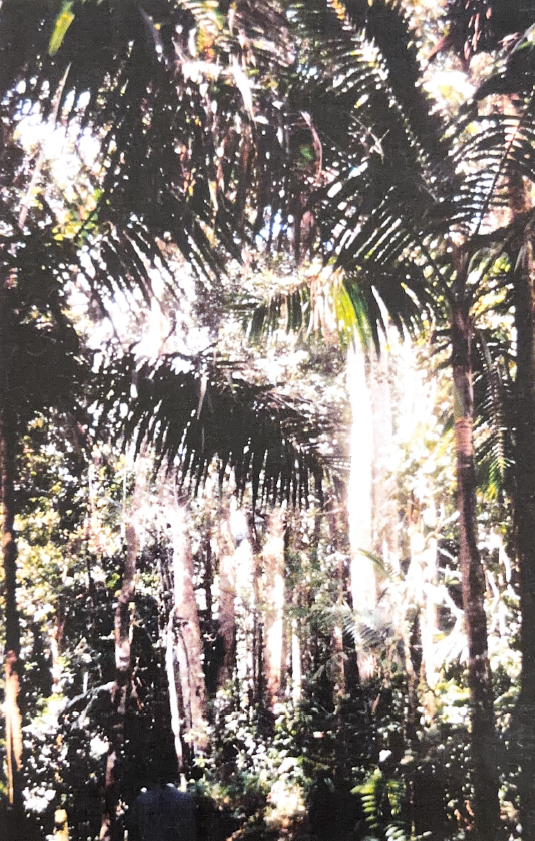
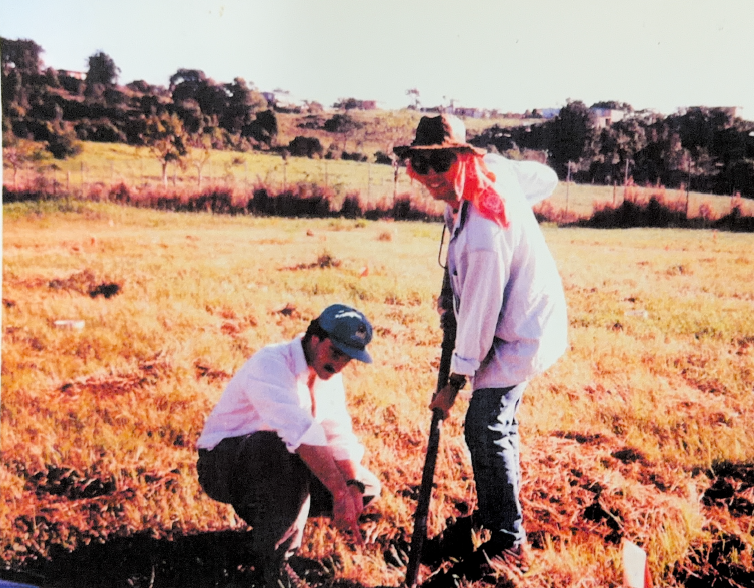
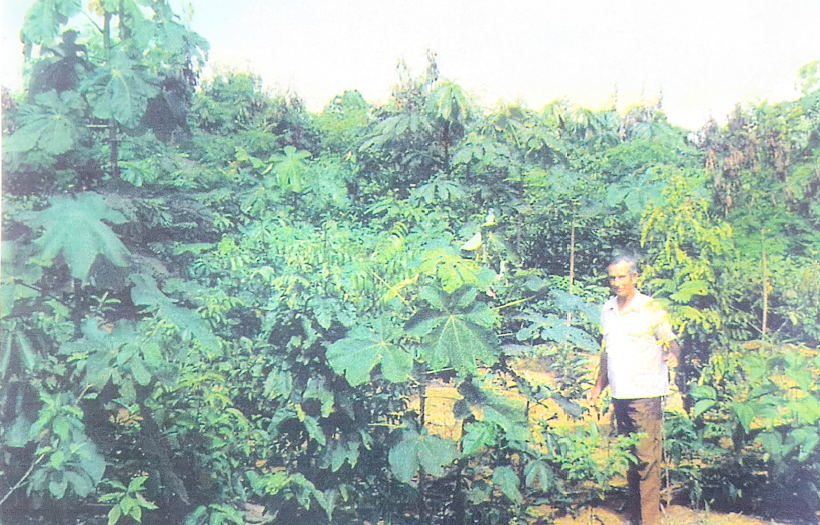
The scientists selected four types of areas to study. They studied old tropical forests, young tropical forests, pastures that were currently being used for raising cattle, and recently abandoned pastures (Figures 3-5).

An old Tropical Forest

Figure 3. An old tropical forest.

Two people working in a pasture

Figure 4. A current pasture.

A young tropical forest and a person standing in it

Figure 5. A young tropical forest.

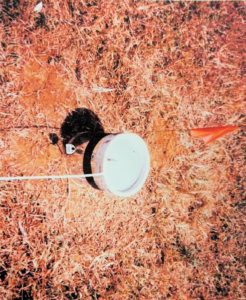
They selected three different areas of each type to study as examples. (How many total areas did they study? Multiply 4 types of areas times 3 examples each.) Then, they picked eight spots in each area where they measured the amount of nitrous oxide (N2O) in the soil. (How many total spots did they measure? Multiply 12 X 8.) The scientists measured the amount of nitrous oxide at the top level of the soil at each spot once a month for 12 months. (How many total measurements did they collect? Multiply 12 X 8 X 12. How many measurements did they collect for each type of area? Divide the total measurements by the number of types.) The scientists collected samples of the gases that were in the soil by placing an instrument 2 centimeters into the soil (Figure 6). (To find out how many inches that is, multiply 2 X .393.) They took the gaseous samples back to a laboratory. There they measured now much nitrous oxide was in the samples collected from the top level of the soil.


The collection device used in the study
Figure 6. Photograph of equipment used to collect nitrous oxide gas.


Reflection Section

Please enable JavaScript in your browser to complete this form.

Click submit to view the answers.

Form entries are not stored.

Loading

Results

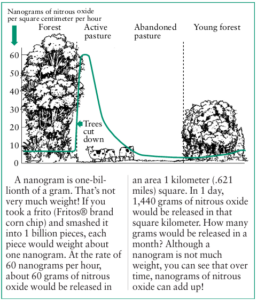
The scientists discovered that the amount of nitrous oxide near the top of the soil was different in the four types of areas (Figure 7).


A graphic showing nitrous oxide in forest, active pasture, abandoned pasture, and young forest. Text reads: A nanogram is one-billionth of a gram. That’s notvery much weight! If you took a frito (Fritos® brand corn chip) and smashed it into 1 billion pieces, each piece would weight about one nanogram. At the rate of 60 nanograms per hour, about 60 grams of nitrous oxide would be released in an area of 1 kilometer (.621 miles) square. In 1 day, 1,440 grams of nitrous oxide would be released in that square kilometer. How many grams would be released in a month? Although a nanogram is not much weight, you can see that over time, nanograms of nitrous oxide can add up!
Figure 7. The amount of nitrous oxide found in the top layer of the soil over the period of 1 hour in four types of tropical land.


The amount of nitrous oxide is low in old tropical forests. When forests are cleared and used for pasture, the amount of nitrous oxide near the soil’s surface rises. As pastures are abandoned and young forests begin to grow, the amount of nitrous oxide at the surface drops to levels even below the old forest levels. The scientists think that water is the key to understanding this pattern. Because cattle hooves compact the soil, pasture land is less able to absorb and drain water. This condition encourages anaerobic bacterial activity on plant and animal wastes near the soil’s surface. This results in an increased amount of nitrous oxide near the soil’s surface, which is then released into the atmosphere.


Reflection Section

Please enable JavaScript in your browser to complete this form.

Click submit to view the answers.

Form entries are not stored.

Loading

Implications

The scientists discovered that nitrous oxide is being released into the atmosphere as a part of the nitrogen cycle. They do not know, however, what causes bacteria to turn some ammonium ions into nitrous oxide and others into nitrogen. Nitrogen is a necessary gas in the atmosphere, but nitrous oxide is a green house gas that could cause harm in great amounts. There is still a lot to learn about tropical soils and greenhouse gases. This research shows that humans impact the Earth in ways that we may not be able to see. By making decisions to manage land in different ways, we affect what
happens now and what will happen in the future.


Reflection Section

Please enable JavaScript in your browser to complete this form.

Click submit to view the answers.

Form entries are not stored.

Loading

From Keller, M. & Reiners, W. A. (1994). Soil-atmosphere exchange of nitrous oxide, nitric oxide, and methane under secondary succession of pasture to forest in the Atlantic lowlands of Costa Rica. Global biogeochemical cycles, 8(4): 399-409.

Cover image for Natural Enquirer Tropical Forest Edition, Volume 3, Number 1 that shows the article names with accompanying graphics.

Part Of

Tropical Forest - Vol. 3 No. 1

Explore Full Journal
SHARE
  • Copy Link
  • Facebook
  • X (Twitter)
  • Pinterest
  • Email
  • Google Classroom
Read Distraction Free Download PDF
  • PDF preview of It's a Gas FACTivity.
    In this FACTivity, you will simulate the greenhouse effect and answer the question: What are the similarities between a glass jar with soil and the Earth’s atmosphere? Materials: Two thermometers...

    FACTivity – It’s a Gas!

    • Activity
    • Middle School
    • 1 Hour
    • Experiment
    • Greenhouse Effect
    • Hands-on
    • Indoor Activity
    • Observation
    • Outdoor Activity
    In this FACTivity, you will simulate the greenhouse effect and answer the question: What are the similarities between a glass jar with soil and the Earth’s atmosphere? Materials: Two thermometers...
    • Explore Activity
    • Download FACTivity (PDF)
    • Explore Activity
    • Download FACTivity (PDF)

    Part Of

    It's a Gas! The Exchange of Gases Between the Soil and the Atmosphere

  • It's a Gas! - Word Search
    Test your knowledge on anaerobic, climate, and the greenhouse effect.

    Word Search – It’s a Gas!

    • Activity
    • Middle School
    • Less than 30 minutes
    • Anaerobic
    • Bacteria
    • Climate
    • Green House Effect
    • Specialization
    • Vocabulary
    Test your knowledge on anaerobic, climate, and the greenhouse effect.
    • Explore Activity
    • Download Word Search (PDF)
    • Answer Key (PDF)
    • Explore Activity
    • Download Word Search (PDF)
    • Answer Key (PDF)

    Part Of

    It's a Gas! The Exchange of Gases Between the Soil and the Atmosphere

Download PDF

Jump To

  • Education Standards
  • Educator Guide
  • Lesson Plans
  • Education Files

Standards addressed in this Article:

The Next Generation Science Standards (NGSS) are a set of K-12 science education standards emphasizing inquiry-based learning, real-world applications, and integrating engineering practices, aiming to deepen understanding of science while promoting critical thinking and problem-solving skills.
  • ESS3.C-M1
    Human activities have significantly altered the biosphere, sometimes damaging or destroying natural habitats and causing the extinction of other species. But changes to Earth’s environments can have different impacts (negative and positive) for different living things.
  • ESS3.C-M2
    Typically as human populations and per capita consumption of natural resources increase, so do the negative impacts on Earth unless the activities and technologies involved are engineered otherwise.
  • ESS3.D-M1
    Human activities, such as the release of greenhouse gases from burning fossil fuels, are major factors in the current rise in Earth’s mean surface temperature (global warming). Reducing the level of climate change and reducing human vulnerability to whatever climate changes do occur depend on the understanding of climate science, engineering capabilities, and other kinds of knowledge, such as understanding of human behavior, and on applying that knowledge wisely in decisions and activities.
  • LS1.C-M2
    Within individual organisms, food moves through a series of chemical reactions in which it is broken down and rearranged to form new molecules, to support growth, or to release energy.
  • LS2.A-M1
    Organisms, and populations of organisms, are dependent on their environmental interactions both with other living things and with nonliving factors.
  • LS2.B-M1
    Food webs are models that demonstrate how matter and energy are transferred between producers, consumers, and decomposers as the three groups interact within an ecosystem. Transfers of matter into and out of the physical environment occur at every level. Decomposers recycle nutrients from dead plant or animal matter back to the soil in terrestrial environments or to the water in aquatic environments. The atoms that make up the organisms in an ecosystem are cycled repeatedly between the living and nonliving parts of the ecosystem.
  • LS2.C-M1
    Ecosystems are dynamic in nature; their characteristics can vary over time. Disruptions to any physical or biological component of an ecosystem can lead to shifts in all its populations.
  • PS1.A-M1
    Substances are made from different types of atoms, which combine with one another in various ways. Atoms form molecules that range in size from two to thousands of atoms.
  • PS1.B-M1
    Substances react chemically in characteristic ways. In a chemical process, the atoms that make up the original substances are regrouped into different molecules, and these new substances have different properties from those of the reactants.
  • PS3.D-M1
    The chemical reaction by which plants produce complex food molecules (sugars) requires an energy input (i.e., from sunlight) to occur. In this reaction, carbon dioxide and water combine to form carbon-based organic molecules and release oxygen.
  • PS3.D-M2
    Cellular respiration in plants and animals involve chemical reactions with oxygen that release stored energy. In these processes, complex molecules containing carbon react with oxygen to produce carbon dioxide and other materials.
The Common Core Standards are educational benchmarks in the United States that outline clear expectations for what students should know and be able to do in English language arts and mathematics from kindergarten through 12th grade, aiming to ensure consistency and coherence in education nationwide.
  • Cite specific textual evidence to support analysis of science and technical texts.
  • By the end of grade 8, read and comprehend science/technical texts in the grades 6-8 text complexity band independently and proficiently.
  • Determine the central ideas or conclusions of a text; provide an accurate summary of the text distinct from prior knowledge or opinions.
  • Follow precisely a multistep procedure when carrying out experiments, taking measurements, or performing technical tasks.
  • Determine the meaning of symbols, key terms, and other domain-specific words and phrases as they are used in a specific scientific or technical context relevant to grades 6-8 texts and topics.
  • Analyze the structure an author uses to organize a text, including how the major sections contribute to the whole and to an understanding of the topic.
  • Analyze the author's purpose in providing an explanation, describing a procedure, or discussing an experiment in a text.
  • Integrate quantitative or technical information expressed in words in a text with a version of that information expressed visually (e.g., in a flowchart, diagram, model, graph, or table).
  • Distinguish among facts, reasoned judgment based on research findings, and speculation in a text.
  • Compare and contrast the information gained from experiments, simulations, video, or multimedia sources with that gained from reading a text on the same topic.
Social Studies Standards are educational guidelines outlining the essential knowledge, skills, and concepts students should learn in subjects such as history, geography, civics, and economics, aiming to provide a comprehensive understanding of societal structures, historical events, and global perspectives.
  • People, Places, and Environments
  • Science, Technology, and Society
  • Time, Continuity, and Change

What Is a Natural Inquirer Monograph?

3 Natural Inquirer monograph covers.


A Natural Inquirer monograph is a short publication that focuses on a single research study. Monographs are written for a middle school audience, but they can also be adapted for both high school students and advanced upper elementary students.

Monographs include:

  • One article based on a published, peer-reviewed research paper; the article keeps the research paper format (see more below) but is written in language students can understand.
  • A FACTivity, which is an activity to complete after reading the article. The FACTivity helps reinforce major science concepts from the article. These activities are designed to be easy to implement, with few material requirements and options for adapting them for your audience or available resources. Some monograph may have two FACTivities.
  • A short “Welcome to the monograph” article about key background information and science concepts.
  • A glossary of new terms from the article or the introductory materials.
  • A list of related Natural Inquirer publications as well as outside references.
  • Standards correlations, including Next Generation Science Standards, addressed in both the article and the FACTivity.

Monographs may also include additional essays (called spotlights), other activities (like crossword puzzles or vocabulary challenges), and more.
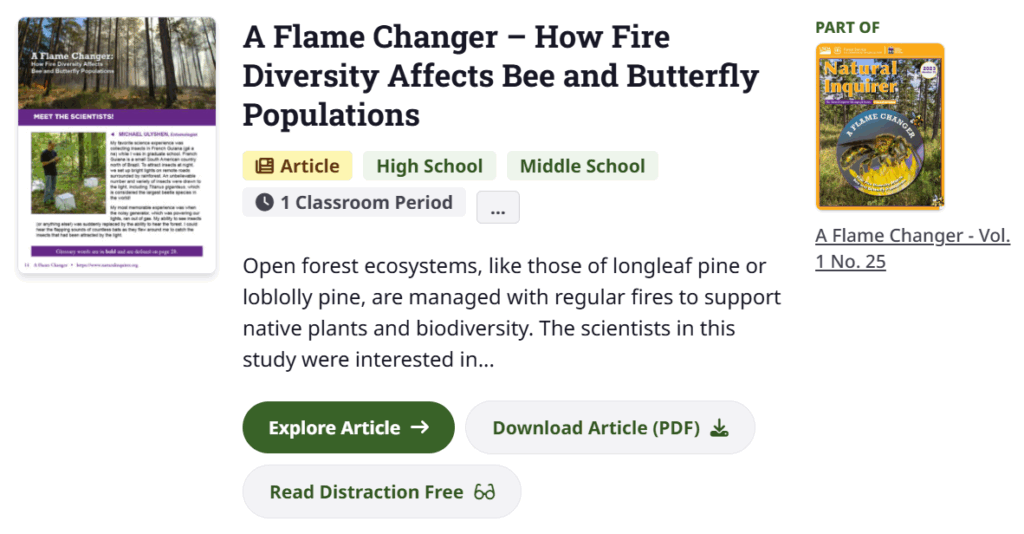
 

A screenshot of the article resource tile for "A Flame Changer" showing the three different format option buttons.

Reading Modes

Monographs are available in three different formats:

  • Hard copies can be ordered from the website and shipped, all free of charge.
  • PDF versions of the printed monograph can be downloaded free on the website. The PDF version directly replicates the content and layout of the printed version.
  • The “Read Distraction Free” option allows the monograph article to open in its own window, without the rest of the website being visible. “Read Distraction Free” is available on the article version of the monograph, which can be opened under the “Articles” tab. This version allows readers to scroll to particular sections of the article using the sidebar menu on the left side of the screen. This version also has interactive Reflection Sections and Number Crunches. Students can enter their answers, submit them, and then receive the correct answers to double-check their work. Submitted answers are not saved on the website and will disappear once the window is closed.

What's in a Natural Inquirer Article?

Here, we'll go into more detail about the parts of a Natural Inquirer article and give you some ideas about how they can be used.
  1. Meet the Scientists

    This section introduces the scientists (and others) who worked on the study. In their own words, they each share a memorable science experience, a favorite research project, or something they learned during the course of their education or research.

    Use this section to:

    • Introduce kids to the variety of people who work in science
    • Introduce kids to the variety of scientific fields and give brief descriptions of science-related jobs
    • Explore ways that people interact with science every day

    Next Generation Science Standards (NGSS) applications:

    • Science and Engineering Practices
    • Crosscutting Concepts: Influence of Science, Engineering, and Technology on Society and the Natural World

    Note that specific standards for this particular monograph are linked on this educator guide tab.

    Other resources:

    Many of the scientists and engineers featured in this section are also featured on our collector cards. Learn more about their work, how they got interested in their fields, and interesting projects they worked on. Cards can be printed as posters, too.
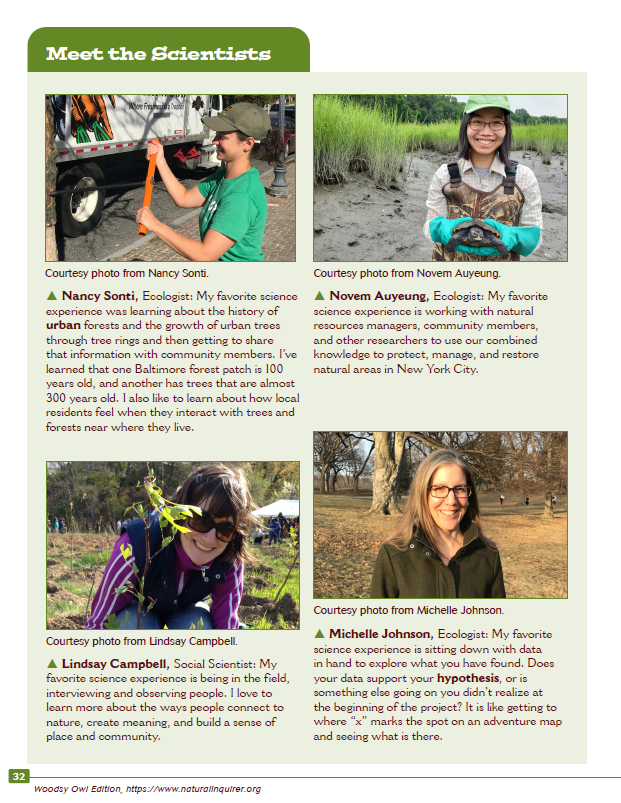
    A sample Meet the Scientists page, showing four different scientists
  2. Thinking About Science

    This section briefly describes a concept about science or scientific research. This overview can touch on topics like

    • study type (longitudinal study, quantitative vs. qualitative data),
    • behaviors of scientists (conducting literature reviews, collaborating with other specialists, replicating earlier studies),
    • the practice of science (the scientific method, engineering design, data collection, randomization, controls and variables),
    • or other aspects of science (bias, correlation vs. causation).

    Use this section to:

    • Reinforce steps in the scientific method and the process of science
    • Encourage students to think about the practice of science and what it can and cannot tell us
    • Consider the many types of scientific study and what information each type can provide

    Next Generation Science Standards applications:

    • Science and Engineering Practices
    • Life Science Disciplinary Core Ideas (depending on topic)
    • Most Crosscutting Concepts (depending on topic)

    Note that specific standards for this particular monograph are linked on this educator guide tab.

    Other resources:

    You can use key words to search for other or related scientific topics on our website (e.g. “longitudinal study,” “bias,” or “sampling”).
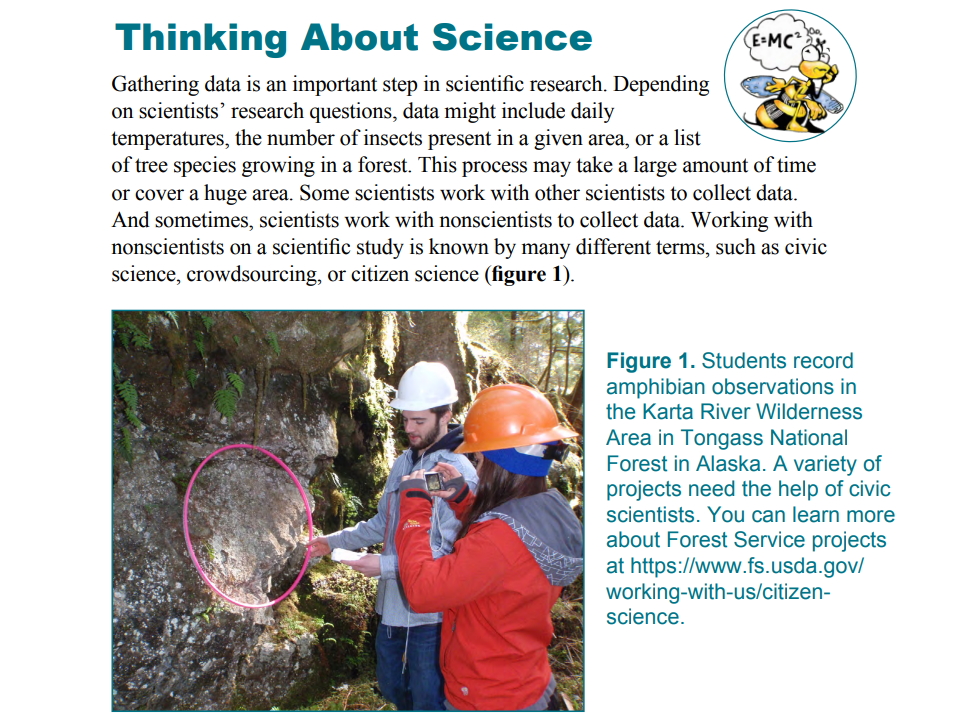
    A sample Thinking About Science page from a recent monograph
  3. Thinking About the Environment

    This section provides a brief overview of a topic or concept in environmental/life science. The topic or concept is directly related to the research study that follows. Examples of topics include the carbon cycle, the water cycle, habitat fragmentation, phenology, biodiversity, and ecosystem services.

    Use this section to:

    • Provide important background information to help students understand the research study
    • Serve as a quick reference during reading or class instruction
    • Connect the research article with other activities or media on the same topic

    Next Generation Science Standards applications:

    • Life Science and some Earth Science Disciplinary Core Ideas (depending on topic)
    • Most Crosscutting Concepts (depending on topic)

    Note that specific standards for this particular monograph are linked on this educator guide tab.

    Other resources:

    You can use key words to search for more resources on life or earth science topics on our website (e.g. “habitat,” “carbon,” or “genetics”).
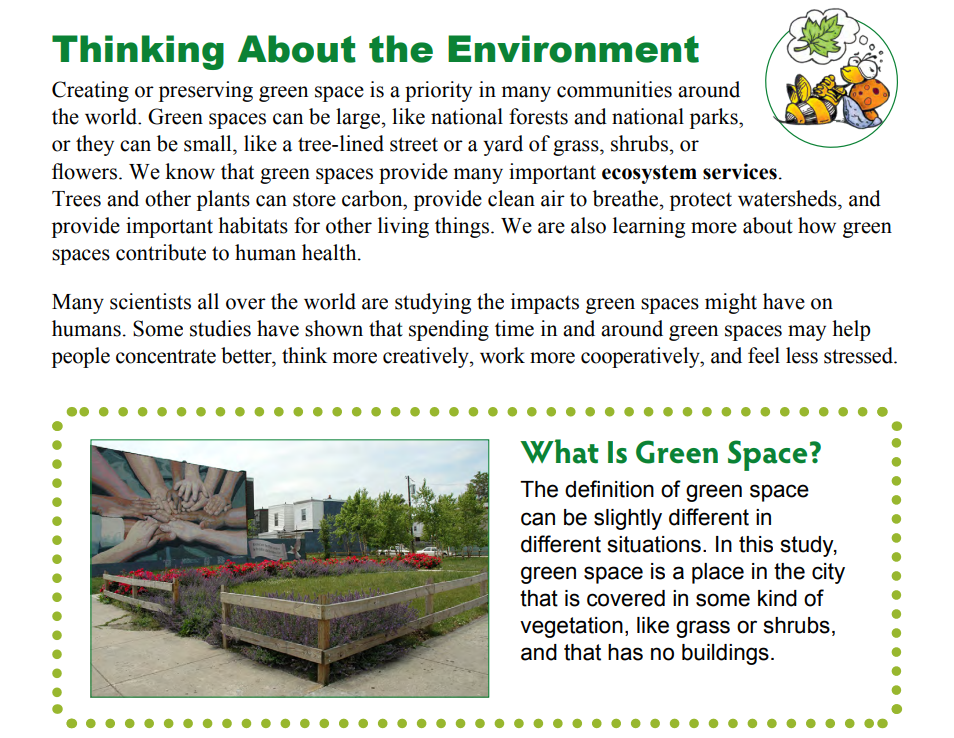
    A sample "Thinking About the Environment" section from a recent monograph
  4. Introduction

    This section begins the scientific article format. Much like the published, peer-reviewed study this article is based on, the introduction provides background information for the study – what is currently known and what remains unknown. The introduction culminates in the question(s) the study hopes to answer.

    The introduction is also the first section with a Reflection Section. This section includes two or three questions to help kids reflect on what they’ve just learned in the Introduction. If they are using the online distraction-free reading mode, they can answer these questions directly on the website.

    Use this section to:

    • Review important background information that kids need to understand the study
    • Connect the study to the concepts addressed in the Thinking About Science and Thinking About the Environment sections
    • Understand research questions and hypotheses, including generating their own hypotheses given what they already know

    Next Generation Science Standards applications:

    • Life Science and some Earth Science Disciplinary Core Ideas (depending on topic)
    • Most Crosscutting Concepts (depending on topic)

    Note that specific standards for this particular monograph are linked on this educator guide tab.

    Other resources:

    Use one of the guided reading lesson plans to help kids follow the format of a scientific paper.
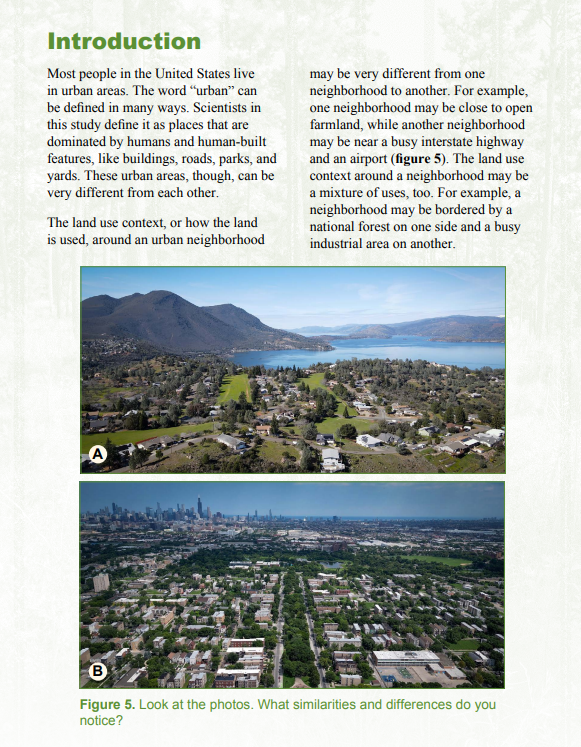
    A sample introduction page from "Hidden in Plain Sight"
  5. Methods

    This section is the nuts and bolts of the study design – the who, what, when, where, why, and how of the research. Contained within the Methods section are usually maps of the study location or the set-up of study plots, as well as details about what data was collected and how.

    The Methods section also ends with a Reflection Section – two or three questions to help students think through what they just read. These questions are interactive on the distraction-free reading mode.

    Use this section to:

    • Show students how experiments and studies are designed and carried out
    • Explore sampling methods and randomization
    • Introduce various data collection tools (e.g. camera traps, surveys, insect collection tools, weather stations, etc.)
    • Explain bias and how studies are designed to remove bias
    • Help students gain experience with map reading

    Next Generation Science Standards applications:

    • Life Science and some Earth Science Disciplinary Core Ideas (depending on topic)
    • Most Crosscutting Concepts (depending on topic)

    Note that specific standards for this particular monograph are linked on this educator guide tab.

    Other resources:

    Many Methods and Findings sections contain Number Crunches, which are simple math exercises designed to help students interact with the data from the study.
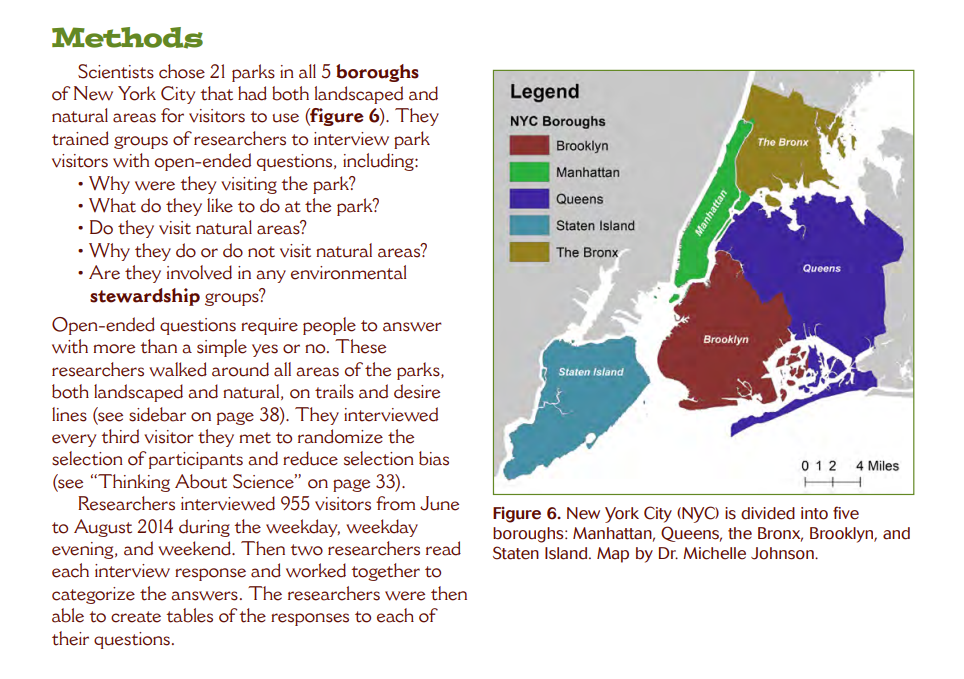
    A sample methods section of a monograph article showing a map
  6. Findings

    This section summarizes the data collected during the study. The Findings section usually includes data tables or graphs and highlights the significant data points from the study. This section often mentions statistical analysis or the use of computer programs to model or analyze the data, though these methods are only discussed generally.

    The Findings section also ends with a Reflection Section – two or three questions to help students think through what they just read. These questions are interactive on the distraction-free reading mode.

    Use this section to:

    • Have students practice reading and interpreting graphs and tables
    • Compare results between variables and controls
    • Explain the concept of statistical significance
    • Discuss how no data or negative results still provide valuable information

    Next Generation Science Standards applications:

    • Life Science and some Earth Science Disciplinary Core Ideas (depending on topic)
    • Most Crosscutting Concepts (depending on topic)

    Note that specific standards for this particular monograph are linked on this educator guide tab.

    Other resources:

    Search the website for “map” or “graph” to find activities where students can practice making and reading maps and graphs.
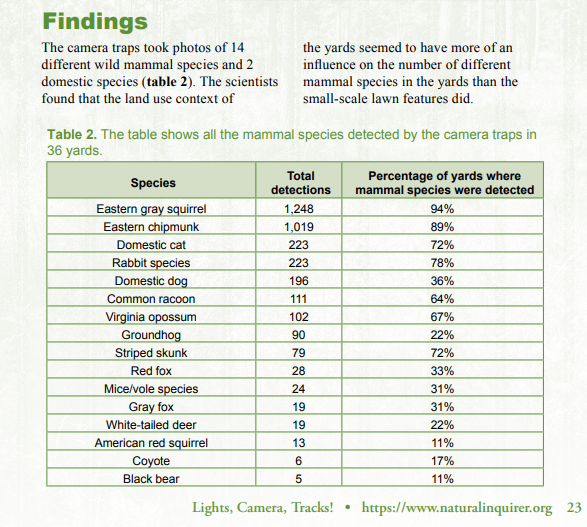
    The beginning of a Findings section featuring a large data table
  7. Discussion

    This section concludes each monograph article. In it, we summarize the main findings of the scientists’ study. Additionally, we present the scientists’ ideas about the limitations of their study, the big-picture impacts of their research, and the scientists’ plans for future study or action.

    The Discussion section ends with a Reflection Section – two or three questions to help students think through what they just read, especially general take-aways from the study. These questions are interactive on the distraction-free reading mode.

    Use this section to:

    • Discuss what conclusions can and cannot be drawn from the available data
    • Explain the difference between correlation and causation
    • Explore study limitations and opportunities for further study
    • Brainstorm ways the study findings could be applied to real-world situations

    Next Generation Science Standards applications:

    • Life Science and some Earth Science Disciplinary Core Ideas (depending on topic)
    • Most Crosscutting Concepts (depending on topic)

    Note that specific standards for this particular monograph are linked on this educator guide tab.

    Other resources:

    Use the “Designing Your Own Study” resource page for videos of scientists discussing their own research studies. The page also includes educator resources to help students plan their own scientific studies.
    The beginning of the conclusion of "Hidden in Plain Sight"

Additional Resources on the Website

A screenshot of the product tabs for an NI monographOn the website, we pair each monograph with a variety of other resources, as well. Use the tabs on the product page to browse through the following:

  • Related activities, including the FACTivity for each article
  • An “About” essay that gives some larger context for the research the scientists conducted or more information about the science topic from the article
  • A glossary of all boldfaced terms from the article
  • A “Scientists and Collaborators” page that lists the people involved in the study; click on a researcher to reach their bio page and see what other articles they might be featured in
  • A “Related Content” page that lists both Natural Inquirer resources about similar topics and also outside reference materials

Article Selection and Review

Natural Inquirer partners with the USDA Forest Service, so we source research studies by Forest Service scientists that have been peer-reviewed and published in reputable journals. Some of our articles have also been created in collaboration with scientists from other Federal agencies, such as U.S. Geological Survey and the United Nations Food and Agriculture Organization, universities, and other non-profits.

All monograph articles are reviewed by scientists who conducted the original research study to verify scientific accuracy. Monographs are also reviewed by student editorial review boards of middle or high school students before publication. Additionally, all monographs are reviewed by the Forest Service and the U.S. Department of Agriculture before publication.

A screenshot of the citation for "Lights, Camera, Tracks"Every monograph article includes a citation of its source study. Many educators pair the original research paper with our article to help more advanced students learn how to read formal research papers. The monograph article then serves as adapted primary literature, bridging the two articles.

Lessons

  • PDF Preview of Lesson Plan for It's a Gas
    In this lesson plan, students will complete a guided reading of a Natural Inquirer article and then will evaluate the impacts of the scientists’ research on their own behaviors. This...

    Lesson Plan – Guided Reading and Implications

    • Lesson Plan
    • Middle School
    • 1 Classroom Period
    • 2-3 Classroom Periods
    • Applied Science
    • Guided reading
    • Reading Comprehension
    • Reading for Information
    In this lesson plan, students will complete a guided reading of a Natural Inquirer article and then will evaluate the impacts of the scientists’ research on their own behaviors. This...
    • Explore Lesson Plan
    • Download Lesson Plan (PDF)
    • Explore Lesson Plan
    • Download Lesson Plan (PDF)

    Part Of

    It's a Gas! The Exchange of Gases Between the Soil and the Atmosphere

  • PDF preview of the Questions Only lesson plan
    The goal of this lesson plan is to help students identify key concepts and develop their own interpretations of what they read. It includes 42 open-ended questions for them to...

    Lesson Plan – Questions Only

    • Lesson Plan
    • High School
    • Middle School
    • 2-3 Classroom Periods
    • Active Forest Management
    • Agriculture
    • Carbon
    • Citizen Science
    • Engineering and Forest Products
    • Fire
    • Insects
    • Pollinators
    • Pollution
    • Recreation
    • Social Science
    • Water
    • Wilderness
    • Wildlife
    • Class Discussion
    • Interpretation
    • Questions
    The goal of this lesson plan is to help students identify key concepts and develop their own interpretations of what they read. It includes 42 open-ended questions for them to...
    • Explore Lesson Plan
    • Download Lesson Plan (PDF)
    • Explore Lesson Plan
    • Download Lesson Plan (PDF)

    Part Of

    Bioenergy - Vol. 9 No. 1

  • PDF Preview of the KWL Lesson Plan
    Students create a chart to write what they know before reading, what they think they will learn from the article, and then what they learned from the article. This lesson...

    Lesson Plan – K-W-L

    • Lesson Plan
    • High School
    • Middle School
    • 2-3 Classroom Periods
    • Active Forest Management
    • Agriculture
    • Carbon
    • Citizen Science
    • Engineering and Forest Products
    • Fire
    • Insects
    • Pollinators
    • Pollution
    • Recreation
    • Social Science
    • Water
    • Wilderness
    • Wildlife
    • Graphic Organizer
    Students create a chart to write what they know before reading, what they think they will learn from the article, and then what they learned from the article. This lesson...
    • Explore Lesson Plan
    • Download Lesson Plan (PDF)
    • Explore Lesson Plan
    • Download Lesson Plan (PDF)
  • PDF Preview of the Paragraph by Paragraph Lesson Plan
    Focus student understanding of the main idea of a paragraph in each section of a Natural Inquirer article through a reading and note-taking process. This lesson plan can be used with any...

    Lesson Plan – Paragraph by Paragraph

    • Lesson Plan
    • High School
    • Middle School
    • 2-3 Classroom Periods
    • Active Forest Management
    • Agriculture
    • Carbon
    • Citizen Science
    • Engineering and Forest Products
    • Fire
    • Insects
    • Pollinators
    • Pollution
    • Recreation
    • Social Science
    • Water
    • Wilderness
    • Wildlife
    • Graphic Organizer
    Focus student understanding of the main idea of a paragraph in each section of a Natural Inquirer article through a reading and note-taking process. This lesson plan can be used with any...
    • Explore Lesson Plan
    • Download Lesson Plan (PDF)
    • Explore Lesson Plan
    • Download Lesson Plan (PDF)

Education Files

Glossary

View All Glossary
  • anaerobic

    (an ǝ rō bik): Living, active, occurring, or existing in the absence of free oxygen.

  • bacteria

    (bak tir ē ǝ): (Singular: bacterium) A group of single-celled microorganisms that live in soil, water, the bodies of plants and animals, or matter obtained from living things and are important because of their chemical effects and disease-causing abilities.

  • climate

    (klī mǝt): The average weather conditions of a particular place or region over a period of years.

  • compacted

    (kǝm pak tǝd): Having a dense structure or parts or units closely packed or joined.

  • gaseous

    (ga sē ǝs or ga shǝs): Having the form of or being gas.

  • greenhouse effect

    (grēn hau̇s i fekt): A warming of Earth’s surface and the air above it caused by gases in the air that trap energy from the Sun.

  • porous

    (pȯr ǝs): Full of tiny openings or spaces (as in the skin or the soil); capable of absorbing liquids.

  • sample

    (sam pəl): A small subset group, representative of the entire group.

  • specialization

    (spe sh(ǝ) lǝ zā shǝn): Being designed, trained, or fitted for one particular purpose or job or area of study.

  • A black and white photo of Dr. Michael Keller working in the field.

    Michael Keller

    Physical Scientist

    I like being a scientist because I get to follow my natural curiosity to learn how the Earth system works. My work is split between the field, the office, and...
    View Profile
Back to Top
  • Natural Inquirer - Homepage
  • USDA
  • USDA Forest Service logo.

The Natural Inquirer program produces a variety of science education materials for PreK through grade 12. Natural Inquirer products are produced by the USDA Forest Service and other cooperators and partners.

Please enable JavaScript in your browser to complete this form.
* denotes mandatory fields
Loading
  • Facebook
  • Pinterest
  • X, formerly Twitter
  • YouTube
  • About Natural Inquirer
  • Team
  • Partners
  • Press & Past Events
  • Contact Us
  • Accessibility Policy
  • Privacy Policy
  • Shipping Policy
© 2026 - Natural Inquirer | Website Credit