Natural Inquirer - Homepage

Free Science Materials for K-12 Students

  • Bookmarks
  • Account
  • USDA
  • USDA Forest Service logo.
Natural Inquirer - Homepage
  • About
    • About Natural Inquirer
    • Team
    • Partners
    • Press & Past Events
    • Contact Us
  • Resources
    • View All Resources
    • Grade Levels
      • PreK - 2nd Grade
      • Upper Elementary
      • Middle School
      • High School
      • All Grade Levels
    • Resource Types
      • Articles
      • Activities
      • Collector Cards
      • Coloring Pages
      • Videos
      • Lesson Plans
      • Scientists & Collaborators
      • Spotlights
      • Virtual Learning Adventures
      • All Types
    • Resource Topics
      • Wilderness
      • Wildlife
      • Water
      • Active Forest Management
      • Social Science
      • Fire
      • Agriculture
      • Recreation
      • Carbon
      • Insects
      • All Topics
    • Special Collections
      • Artemis Moon Trees
      • Career Exploration
      • Experimental Forests & Ranges
      • Project Learning Tree Connections
      • Globe Connections
      • Designing Your Own Study
      • Smokey Bear
      • Spanish Editions
      • Woodsy Owl
      • Virtual Learning Adventures
      • World's Forests
      • All Special Collections
  • Order Materials
    • View All Products
    • Journals & Monographs
    • Readers
    • Collector Card Packs
    • Coloring Books
  • Educators
    • For Educators
      • Educator Guide
      • Educator Blog
      • Newsletter
    • Classroom Ready Resources
      • Activities
      • Career Exploration
      • Lesson Plans
      • Learning Modules
      • GLOBE Connections
      • Project Learning Tree
    • Get Involved
      • Volunteer Your Classroom
  • Career Exploration
  • Bookmarks
  • Account
  • About
    • About Natural Inquirer
    • Team
    • Partners
    • Press & Past Events
    • Contact
  • Resources
        • View All Resources
        • By Grade
          • PreK - 2nd
          • Upper Elementary
          • Middle School
          • High School
        • By Type
          • Articles
          • Activities
          • Collector Cards
          • Coloring Pages
          • Videos
          • Lesson Plans
          • Learning Modules
          • Journals
          • Monographs
          • Readers
          • Scientists & Collaborators
          • Spotlights
          • Virtual Learning Adventures
          • All Types
        • By Topic
          • Agriculture
          • Active Forest Management
          • Carbon
          • Fire
          • Grasslands
          • Insects
          • Recreation
          • Social Science
          • Water
          • Wilderness
          • Wildlife
          • All Topics
        • Special Collections
          • Artemis Moon Trees
          • Career Exploration
          • Experimental Forests and Ranges
          • GLOBE Connections
          • Project Learning Tree Connections
          • Designing Your Own Study
          • Smokey Bear
          • Spanish Editions
          • Virtual Learning Adventures
          • Woodsy Owl
          • World's Forests
          • All Special Collections
  • Order Materials
        • Download all resources - FREE!

          We will be pausing our services beginning September 25, 2026. We are waiting on a new agreement to be put in a place and are hopeful this pause will be temporary. The website will be available during this time to download and use materials; however, we will not be able to mail hard copies of materials or provide customer support during this time. If you have any questions or concerns about the program, please email SM.FS.RDPublicWeb@usda.gov. We have enjoyed serving you and hope to be able to do so again in the near future.

          View All Products
        • Journals & Monographs

          Journals focus on a group of related articles, while monographs focus on one research article.

          Journals & Monographs
        • Collector Cards

          Learn about possible career opportunities in science!

          View All Card Packs
        • Readers

          For a PreK-2nd grade audience, each Reader focuses on one Forest Service scientist and their research.

          View All Readers
        • Coloring and Activity Books

          Learn more about science through our coloring and outdoor activity books!

          View All Coloring and Activity Books
  • Educators
        • Overview
          • General Educator Guide
          • PreK-2nd Grade Guide
          • Upper Elementary School Guide
          • Middle and High School Guide
          • Non-Formal Education Guide
        • Classroom Ready Resources
          • Career Exploration
          • Learning Modules
          • Lesson Plans
          • Explore All
        • Order Materials
          • View All Free Products
          • Contact Us
        • For Educators
          • Educator Blog
          • Newsletter
          • Project Learning Tree
        • Get Involved
          • Volunteer Your Classroom
  • Career Exploration

Breadcrumb

  • Home
  • Resources
  • Are You Red-dy to Change? Learning What Things Affect Leaf Color Change
PDF Preview of Investi-gator (Northern Research Station) article "Are You Red-Dy for Change?"
Bookmark
Please login to bookmark Close

Please login to bookmark


Lost your password?

No account yet? Register

Are You Red-dy to Change? Learning What Things Affect Leaf Color Change

  • Article
  • Upper Elementary
  • 1 Classroom Period
  • Air Temperature
  • Climate
  • Deciduous Trees
  • Leaf Change
  • Nitrogen
  • Phenology
PDF Preview of Investi-gator (Northern Research Station) article "Are You Red-Dy for Change?"
SHARE
  • Copy Link
  • Facebook
  • X (Twitter)
  • Pinterest
  • Email
  • Google Classroom

Leaves change color in the fall. Cooler temperatures in the fall cause the chlorophyll in leaves to break down. When chlorophyll, which is green, begins to break down in leaves, the yellow or red color becomes more visible. In this study, the scientists wanted to know if air temperature, the length of daylight, or the chemicals in the leaves was more likely to result in leaf color change in sugar maple trees.

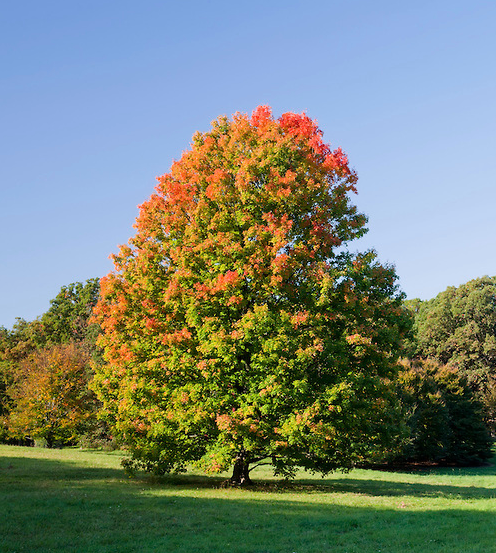
Are You Red-dy to Change? Learning What Things Affect Leaf Color Change

Jump To

  • Meet the Scientists
  • Thinking About Science
  • Thinking About the Environment
  • Introduction
  • Method
  • Findings
  • Discussion

Meet the Scientists

Paul Schaberg

Paul Schaberg

Plant Physiologist

My favorite science experience is getting an unexpected result to an experiment. Sure, it is great to develop a hypothesis and test it in an experiment. A hypothesis is an... Read Full Bio
Paula Murakami

Paula Murakami

Biological Sciences Lab Technician

My favorite science experience is the opportunity to learn new things! Whether it is in the laboratory or in the woods, there is always something new to be discovered. Recently... Read Full Bio
John Shane

John Shane

Professor of Forestry

My favorite science experience was figuring out the movements of the Moon and their effects on the Moon’s nightly arc over all different moon phases and seasons. It was the... Read Full Bio
Abby van den Berg

Abby van den Berg

Professor of Plant Biology

I currently do research on the maple sugaring process. One of my favorite science experiences is talking to maple sugarmakers about the results of a research project. It’s a great... Read Full Bio

Thinking About Science

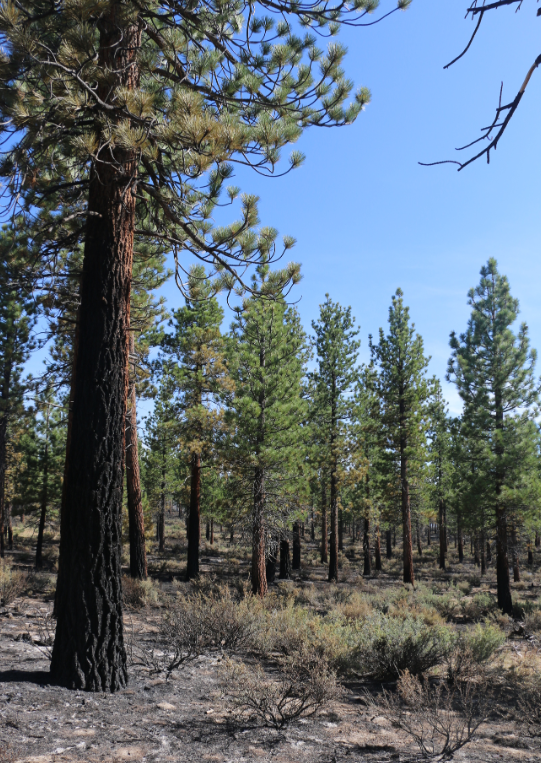
Scientists learn things through observation. Observation is carefully examining something to understand it better. Sometimes scientists observe plants to learn about them. In this study scientists observed leaves. They observed leaves on deciduous trees. These trees lose their leaves in the fall or winter (figure 1a and 1b). The scientists observed the change in leaf color. They did this because they wanted to know why and when leaves change color.


A sugar maple tree in a field with many trees behind it

Figure 1a. Examine this deciduous tree. Do deciduous trees grow in your area? If so, name three of them. U.S. Fish and Wildlife Service photo by Chris Aquino.

Pine trees in a dry area

Figure 1b. Non-deciduous trees do not lose their leaves in the winter. They are called coniferous trees. U.S. Forest Service photo by Kerry Greene.

Have you ever gone to the mountains to see the leaves change color? If so, you are not alone. Many people go to the mountains to see the leaves change color in the fall. Scientists knew that if they can predict when leaves will change color, this information will help people plan their trips.

You can see that science helps people in many ways. In this case, it can help people to enjoy the leaf color change in the fall. Science also helps people in other ways. You will learn about one of those other ways by reading “Thinking About the Environment” section.


Thinking About the Environment

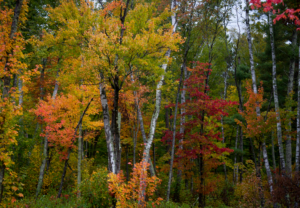
A change in leaf color can tell us important things about trees (figure 2). Think about a plant in your house. Have you ever seen the leaves change color? What happens when the leaves change colors? Leaf color change could be a sign of trouble. Leaves may change color because of sickness or stress. Imagine that some tree leaves change color in June. What do you think this means? It is probably a sign that the tree is unhealthy. Understanding leaf color change can help scientists understand a tree’s health.

Chippewa National Forest putting on a fall color show at the Norway Beach Recreation Area.
Figure 2. This photo shows leaves changing color in the fall. U.S. Forest Service photo.

Introduction

In the fall, thousands of people visit forests. Do you know why? They are probably coming to see the leaves change color! Leaves change color in the fall. Cooler temperatures in the fall cause the chlorophyll in leaves to break down. Chlorophyll is the green color found in plants. When chlorophyll begins to break down in leaves, the yellow color becomes more visible. For some leaves, a red color becomes more visible, too. Red color happens because there is a build up of a chemical called anthocyanin.


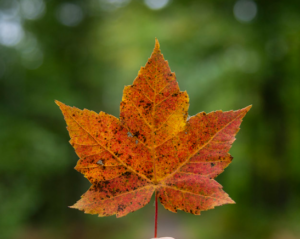
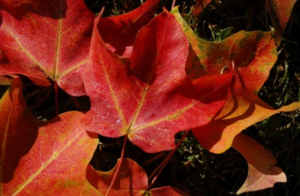
In this study, the scientists wanted to know if air temperature, the length of daylight, or the chemicals in the leaves was more likely to result in leaf color change in sugar maple trees (figure 3). To learn the chemical content of the leaves, scientists studied things like the amount of nitrogen, sugar, and water. Nitrogen is an element. Oxygen is another element you may know. A lot of nitrogen is found in Earth’s atmosphere. Nitrogen is important to plant life.


Orange and red leaf
Figure 3. This leaf has beautiful shades of red color. U.S. Forest Service photo.

Reflection Section

Please enable JavaScript in your browser to complete this form.

Click submit to view the answers.

Form entries are not stored.

Loading

Method

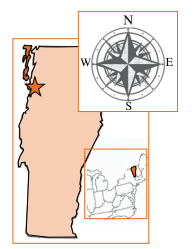
Sixteen sugar maple trees were studied in South Burlington, Vermont (figure 4). A number of leaves from each tree were collected on 12 different dates. They were collected from June to October. Some of the leaves were studied for water, sugar, and nitrogen content.

A map of vermont with a compass and a snapshot of where it is in Northeast America
Figure 4. Vermont is located in the northeastern part of the United States. South Burlington, Vermont is located in the northwestern part of Vermont.

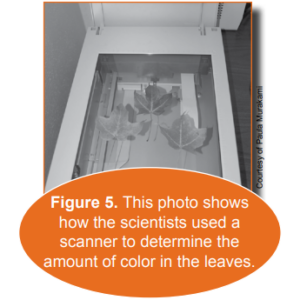
The other leaves were used to measure leaf color. To do this, scientists scanned leaves with a computerized color scanner (figure 5). They then used a computer program to calculate the amount of red, yellow, and green color on each leaf.

A scanner with leaves on it

Once they had this information for some of the leaves from each tree, they were able to estimate the amount of each color on the entire tree. The scientists also collected data about the length of each day (from sunrise to sunset) and air temperature.

Then the scientists used math. They used mathematical equations to understand what they found. An equation is a sentence in math like 2 + 2= 4. They looked at the data to figure out which information would help to predict red color development. The scientists compared how the leaf content of sugar, water and nitrogen, air temperature, daylength, and red color development all influenced each other.

Reflection Section

Please enable JavaScript in your browser to complete this form.

Click submit to view the answers.

Form entries are not stored.

Loading

Findings

The scientists found that the leaves first started to show some red in late September. Then, the leaves changed more completely from green to yellow or red in the middle of October. Scientists found that nitrogen was the best predictor of red color change. They discovered that leaves with less nitrogen turned red earlier. Also, those leaves turned a more complete red than other leaves (figure 6).


several red maple leaves on the forest floor
Figure 6. This photo shows a variety of red colored maple leaves. Photo courtesy of Paula Murakami.


Reflection Section

Please enable JavaScript in your browser to complete this form.

Click submit to view the answers.

Form entries are not stored.

Loading
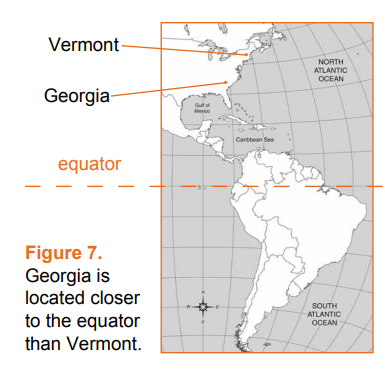
A map showing part of the globe with North and South America, the equator, and highlighting Georgia and Vermont

Figure 7. Georgia is located closer to the equator than Vermont.


Discussion

Collecting and studying the information about the leaves, air temperature, and day length helped scientists. It helped the scientists to understand when leaves were most likely to change color. This information is useful for the following reasons:

  • This information is important for understanding a tree’s health.
  • This information is used each year to estimate dates when leaves will be changing color.
  • Tourists find this information helpful because it helps them plan their visits to forests.
  • It is also helpful to people in towns where tourists visit. Store owners and people who run hotels and gas stations use this information. They use it to plan supply orders. They also use it to schedule enough employees for the times when many tourists are visiting.

As you can see, understanding when leaves will be changing color is good for a lot of people.


Reflection Section

Please enable JavaScript in your browser to complete this form.

Click submit to view the answers.

Form entries are not stored.

Loading

Adapted from: Schaberg, P.G., van den Berg, A.K., Murakami, P.F., Shane, J.B., and Donnelly, J.R. (2003). Factors influencing red expression in autumn foliage of sugar maple trees, Tree Physiology, 23:325-333. http://www.treesearch.fs.fed.us/pubs/6986.

Front cover of Investi-gator (Northern Research Station) with autumn leaves wrapped around the Earth

Part Of

Investi-gator (Northern Research Station) - Vol. 1 No. 1

Explore Full Journal
SHARE
  • Copy Link
  • Facebook
  • X (Twitter)
  • Pinterest
  • Email
  • Google Classroom
Read Distraction Free Download PDF
  • PDF preview of the FACTivity for "Are You Red-dy to Change?"
    In this FACTivity, you will imagine what sugar maple trees in the northeastern United States might look like at four different times during the fall. Materials: Four sheets of plain...

    FACTivity – Are You Red-dy to Change?

    • Activity
    • Upper Elementary
    • 1 Classroom Period
    • Leaf Change
    • Maple Tree
    • Phenology
    • Seasons
    In this FACTivity, you will imagine what sugar maple trees in the northeastern United States might look like at four different times during the fall. Materials: Four sheets of plain...
    • Explore Activity
    • Download FACTivity (PDF)
    • Explore Activity
    • Download FACTivity (PDF)

    Part Of

    Are You Red-dy to Change? Learning What Things Affect Leaf Color Change

Download PDF

Jump To

  • Education Standards
  • Educator Guide
  • Lesson Plans
  • Education Files
  • Project Learning Tree

Standards addressed in this Article:

The Next Generation Science Standards (NGSS) are a set of K-12 science education standards emphasizing inquiry-based learning, real-world applications, and integrating engineering practices, aiming to deepen understanding of science while promoting critical thinking and problem-solving skills.
  • LS2.B-E1
    Matter cycles between the air and soil and among plants, animals, and microbes as these organisms live and die. Organisms obtain gases and water from the environment and release waste matter (gas, liquid, or solid) back into the environment.
  • LS3.A-E2
    Other characteristics result from individuals’ interactions with the environment, which can range from diet to learning. Many characteristics involve both inheritance and environment.
  • LS3.B-E2
    The environment also affects the traits that an organism develops.
  • PS1.A-E3
    Measurements of a variety of properties can be used to identify materials. (Boundary: At this grade level, mass and weight are not distinguished, and no attempt is made to define the unseen particles or explain the atomic-scale mechanism of evaporation and condensation.)
The Common Core Standards are educational benchmarks in the United States that outline clear expectations for what students should know and be able to do in English language arts and mathematics from kindergarten through 12th grade, aiming to ensure consistency and coherence in education nationwide.
  • Refer to details and examples in a text when explaining what the text says explicitly and when drawing inferences from the text.
  • By the end of year, read and comprehend informational texts, including history/social studies, science, and technical texts, in the grades 4–5 text complexity band proficiently, with scaffolding as needed at the high end of the range.
  • Determine the main idea of a text and explain how it is supported by key details; summarize the text.
  • Explain events, procedures, ideas, or concepts in a historical, scientific, or technical text, including what happened and why, based on specific information in the text.
  • Describe the overall structure (e.g., chronology, comparison, cause/effect, problem/solution) of events, ideas, concepts, or information in a text or part of a text.
  • Interpret information presented visually, orally, or quantitatively (e.g., in charts, graphs, diagrams, time lines, animations, or interactive elements on Web pages) and explain how the information contributes to an understanding of the text in which it appears.
  • Explain how an author uses reasons and evidence to support particular points in a text.
  • Quote accurately from a text when explaining what the text says explicitly and when drawing inferences from the text.
  • By the end of the year, read and comprehend informational texts, including history/social studies, science, and technical texts, at the high end of the grades 4–5 text complexity band independently and proficiently.
  • Determine two or more main ideas of a text and explain how they are supported by key details; summarize the text.
  • Explain the relationships or interactions between two or more individuals, events, ideas, or concepts in a historical, scientific, or technical text based on specific information in the text.
  • Determine the meaning of general academic and domain-specific words and phrases in a text relevant to a grade 5 topic or subject area.
  • Compare and contrast the overall structure (e.g., chronology, comparison, cause/effect, problem/solution) of events, ideas, concepts, or information in two or more texts.
  • Draw on information from multiple print or digital sources, demonstrating the ability to locate an answer to a question quickly or to solve a problem efficiently.
  • Explain how an author uses reasons and evidence to support particular points in a text, identifying which reasons and evidence support which point(s).
Social Studies Standards are educational guidelines outlining the essential knowledge, skills, and concepts students should learn in subjects such as history, geography, civics, and economics, aiming to provide a comprehensive understanding of societal structures, historical events, and global perspectives.
  • People, Places, and Environments
  • Science, Technology, and Society
  • Time, Continuity, and Change

What Is an Investi-gator Journal?
A fan of the three Investi-gator covers

An Investi-gator journal is a collection of 4-6 articles on a variety of science topics from a particular region of the United States. These journals are written for upper elementary school students. Investi-gators are similar to our Natural Inquirer journals, but the articles and activities are written for younger students.

Investi-gator journals include:

  • Four to six articles based on published, peer-reviewed research papers; the articles keep the research paper format (see more below) but are written in language students can understand.
  • A FACTivity for each article, which is an activity to complete after reading the article. The FACTivity helps reinforce major science concepts from the article. These activities are designed to be easy to implement, with few material requirements and options for adapting them for your audience or available resources. Some articles in a journal may have two FACTivities.
  • A short “Welcome to the journal” article about key background information and science concepts that unify the articles included in the journal
  • A glossary of new terms for each article and the introductory materials.
  • A list of related Natural Inquirer publications for each article as well as outside references.
  • Standards correlations, including Next Generation Science Standards, addressed in the articles and the FACTivities.

Journals may also include additional essays (called spotlights), other activities (like crossword puzzles or vocabulary challenges), and more.
A screenshot of one of the Investi-gator article's listing showing the different modes of viewing

Reading Modes

Investi-gator journals are currently available in two formats:

  • PDF versions of the printed journal can be downloaded free on the website. The PDF version directly replicates the content and layout of the printed version. You can also download individual articles as pdfs.
  • The “Read Distraction Free” option allows the individual articles to open in their own window, without the rest of the website being visible. These articles can be found under the “Articles” tab. This version allows readers to scroll to particular sections of the article using the sidebar menu on the left side of the screen. This version also has interactive Reflection Sections and Number Crunches. Students can enter their answers, submit them, and then receive the correct answers to double-check their work. Submitted answers are not saved on the website and will disappear once the window is closed.

What's in an Invest-gator Article?

Here, we'll go into more detail about the parts of an Investi-gator article and give you some ideas about how they can be used.
  1. Meet the Scientists

    This section introduces the scientists (and others) who worked on the study. In their own words, they each share a memorable science experience, a favorite research project, or something they learned during the course of their education or research.

    Use this section to:

    • Introduce kids to the variety of people who work in science
    • Introduce kids to the variety of scientific fields and give brief descriptions of science-related jobs
    • Explore ways that people interact with science every day

    Next Generation Science Standards (NGSS) applications:

    • Science and Engineering Practices
    • Crosscutting Concepts: Influence of Science, Engineering, and Technology on Society and the Natural World

    Note that specific standards are linked on this educator guide tab.

    Other resources:

    Many of the scientists and engineers featured in this section are also featured on our collector cards. Learn more about their work, how they got interested in their fields, and interesting projects they worked on. Cards can be printed as posters, too.
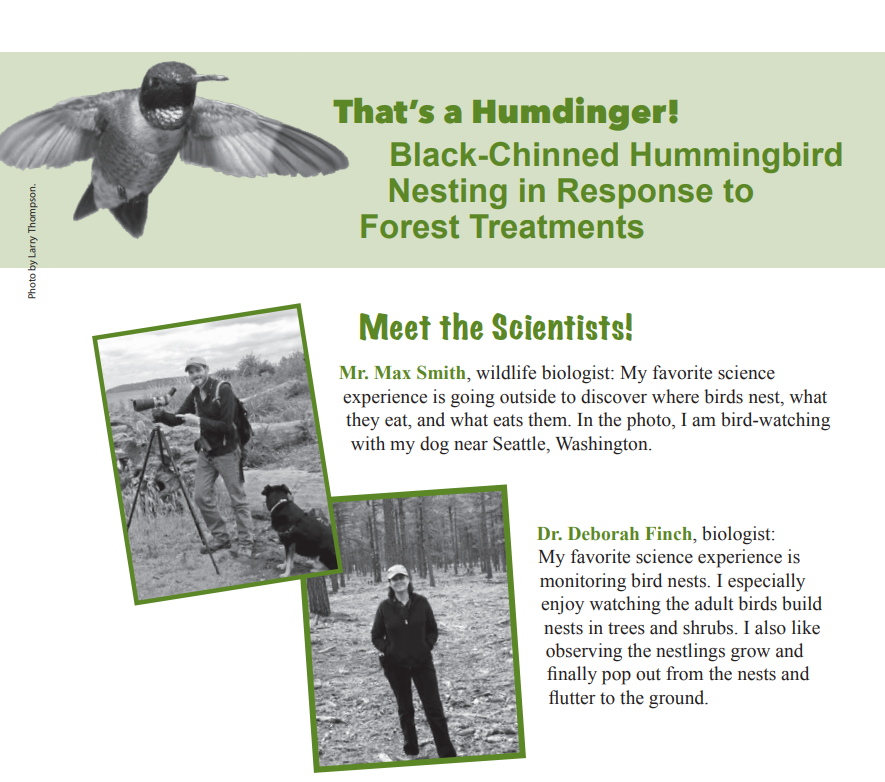
    A sample Meet the Scientists page from an Investi-gator
  2. Thinking About Science

    This section briefly describes a concept about science or scientific research. This overview can touch on topics like

    • study type (longitudinal study, quantitative vs. qualitative data),
    • behaviors of scientists (conducting literature reviews, collaborating with other specialists, replicating earlier studies),
    • the practice of science (the scientific method, engineering design, data collection, randomization, controls and variables),
    • or other aspects of science (bias, correlation vs. causation).

    Use this section to:

    • Reinforce steps in the scientific method and the process of science
    • Encourage students to think about the practice of science and what it can and cannot tell us
    • Consider the many types of scientific study and what information each type can provide

    Next Generation Science Standards applications:

    • Science and Engineering Practices
    • Life Science Disciplinary Core Ideas (depending on topic)
    • Most Crosscutting Concepts (depending on topic)

    Note that specific standards are linked on this educator guide tab.

    Other resources:

    You can use key words to search for other or related scientific topics on our website (e.g. “longitudinal study,” “bias,” or “sampling”).
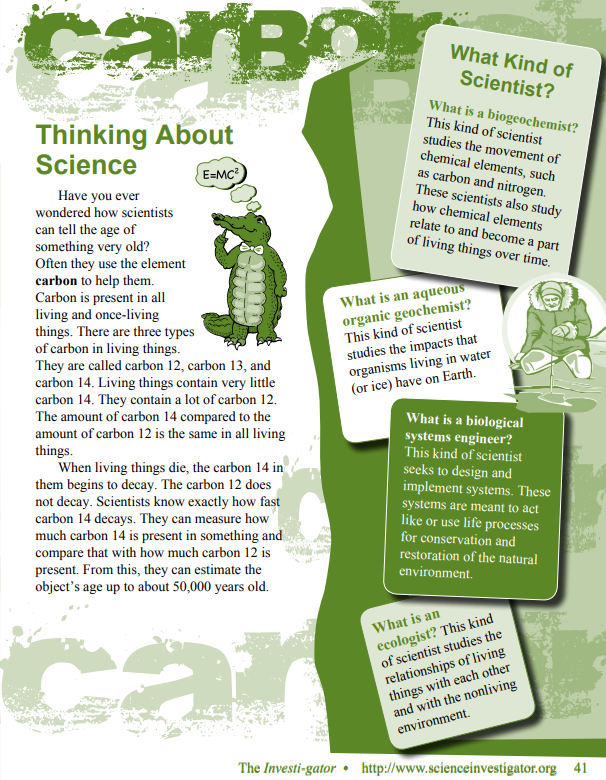
    A sample Thinking About Science page from an Investi-gator
  3. Thinking About the Environment

    This section provides a brief overview of a topic or concept in environmental/life science. The topic or concept is directly related to the research study that follows. Examples of topics include the carbon cycle, the water cycle, habitat fragmentation, phenology, biodiversity, and ecosystem services.

    Use this section to:

    • Provide important background information to help students understand the research study
    • Serve as a quick reference during reading or class instruction
    • Connect the research article with other activities or media on the same topic

    Next Generation Science Standards applications:

    • Life Science and some Earth Science Disciplinary Core Ideas (depending on topic)
    • Most Crosscutting Concepts (depending on topic)

    Note that specific standards are linked on this educator guide tab.

    Other resources:

    You can use key words to search for more resources on life or earth science topics on our website (e.g. “habitat,” “carbon,” or “genetics”).
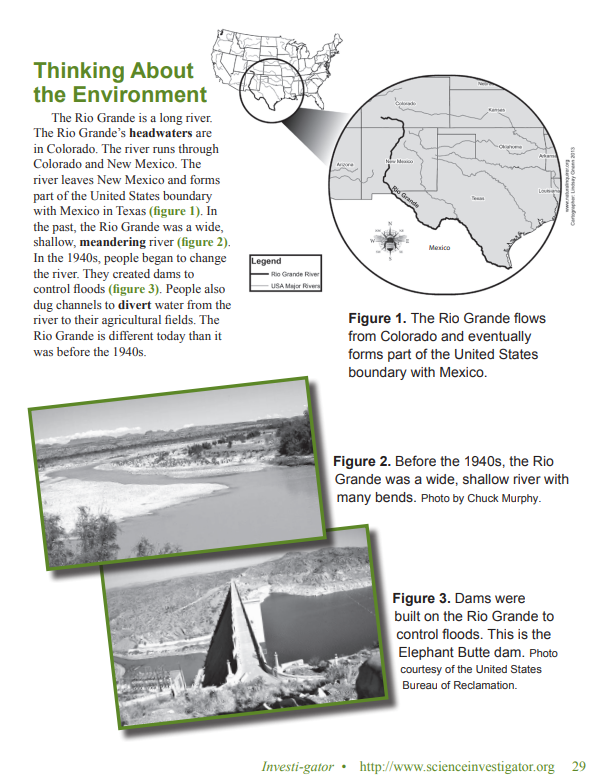
    A sample Thinking About the Environment page from an Investi-gator
  4. Introduction

    This section begins the scientific article format. Much like the published, peer-reviewed study this article is based on, the introduction provides background information for the study – what is currently known and what remains unknown. The introduction culminates in the question(s) the study hopes to answer.

    The introduction is also the first section with a Reflection Section. This section includes two or three questions to help kids reflect on what they’ve just learned in the Introduction. If they are using the online distraction-free reading mode, they can answer these questions directly on the website.

    Use this section to:

    • Review important background information that kids need to understand the study
    • Connect the study to the concepts addressed in the Thinking About Science and Thinking About the Environment sections
    • Understand research questions and hypotheses, including generating their own hypotheses given what they already know

    Next Generation Science Standards applications:

    • Life Science and some Earth Science Disciplinary Core Ideas (depending on topic)
    • Most Crosscutting Concepts (depending on topic)

    Note that specific standards are linked on this educator guide tab.

    Other resources:

    Use one of the guided reading lesson plans to help kids follow the format of a scientific paper.
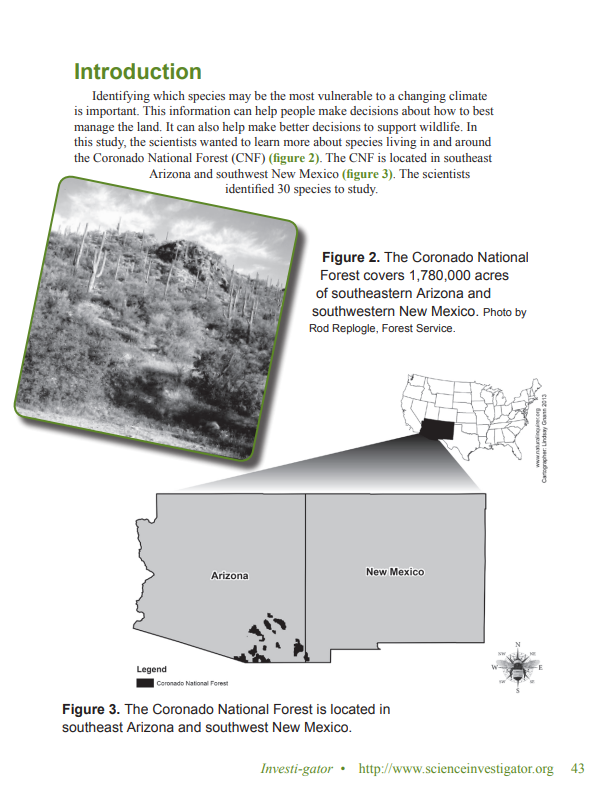
    A sample Introduction from an Investi-gator article
  5. Methods

    This section is the nuts and bolts of the study design – the who, what, when, where, why, and how of the research. Contained within the Methods section are usually maps of the study location or the set-up of study plots, as well as details about what data was collected and how.

    The Methods section also ends with a Reflection Section – two or three questions to help students think through what they just read. These questions are interactive on the distraction-free reading mode.

    Use this section to:

    • Show students how experiments and studies are designed and carried out
    • Explore sampling methods and randomization
    • Introduce various data collection tools (e.g. camera traps, surveys, insect collection tools, weather stations, etc.)
    • Explain bias and how studies are designed to remove bias
    • Help students gain experience with map reading

    Next Generation Science Standards applications:

    • Life Science and some Earth Science Disciplinary Core Ideas (depending on topic)
    • Most Crosscutting Concepts (depending on topic)

    Note that specific standards are linked on this educator guide tab.

    Other resources:

    Many Methods and Findings sections contain Number Crunches, which are simple math exercises designed to help students interact with the data from the study.
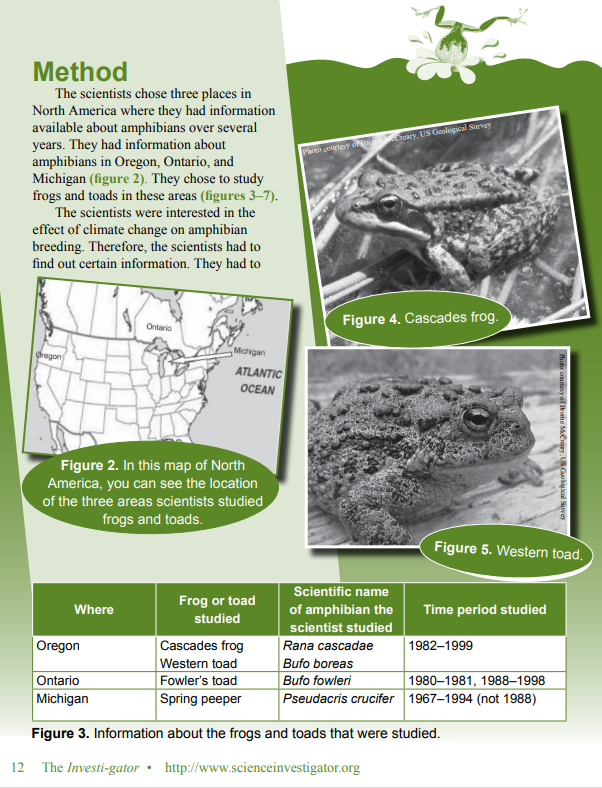
    A sample Methods page from an Investi-gator article
  6. Findings

    This section summarizes the data collected during the study. The Findings section usually includes data tables or graphs and highlights the significant data points from the study. This section often mentions statistical analysis or the use of computer programs to model or analyze the data, though these methods are only discussed generally.

    The Findings section also ends with a Reflection Section – two or three questions to help students think through what they just read. These questions are interactive on the distraction-free reading mode.

    Use this section to:

    • Have students practice reading and interpreting graphs and tables
    • Compare results between variables and controls
    • Explain the concept of statistical significance
    • Discuss how no data or negative results still provide valuable information

    Next Generation Science Standards applications:

    • Life Science and some Earth Science Disciplinary Core Ideas (depending on topic)
    • Most Crosscutting Concepts (depending on topic)

    Note that specific standards are linked on this educator guide tab.

    Other resources:

    Search the website for “map” or “graph” to find activities where students can practice making and reading maps and graphs.
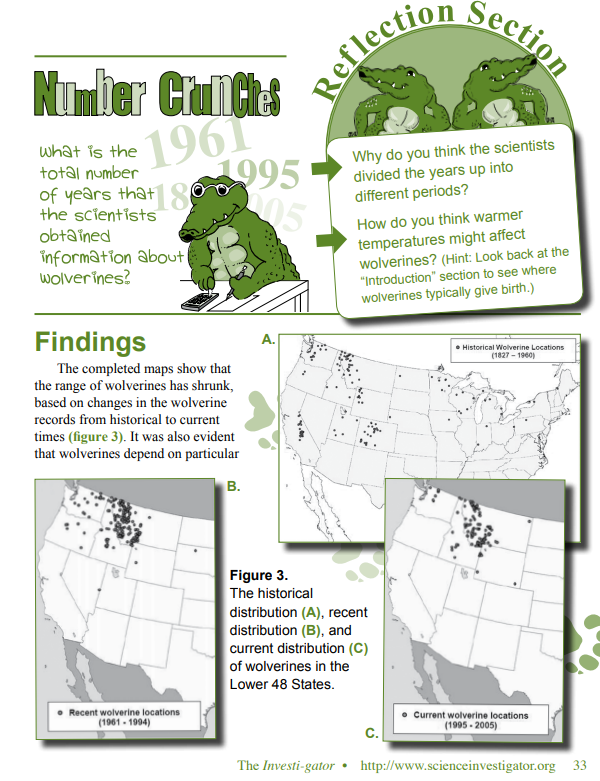
    A sample Findings page from an Investi-gator article
  7. Discussion

    This section concludes each article. In it, we summarize the main findings of the scientists’ study. Additionally, we present the scientists’ ideas about the limitations of their study, the big-picture impacts of their research, and the scientists’ plans for future study or action.

    The Discussion section ends with a Reflection Section – two or three questions to help students think through what they just read, especially general take-aways from the study. These questions are interactive on the distraction-free reading mode.

    Use this section to:

    • Discuss what conclusions can and cannot be drawn from the available data
    • Explain the difference between correlation and causation
    • Explore study limitations and opportunities for further study
    • Brainstorm ways the study findings could be applied to real-world situations

    Next Generation Science Standards applications:

    • Life Science and some Earth Science Disciplinary Core Ideas (depending on topic)
    • Most Crosscutting Concepts (depending on topic)

    Note that specific standards are linked on this educator guide tab.

    Other resources:

    Use the “Designing Your Own Study” resource page for videos of scientists discussing their own research studies. The page also includes educator resources to help students plan their own scientific studies.
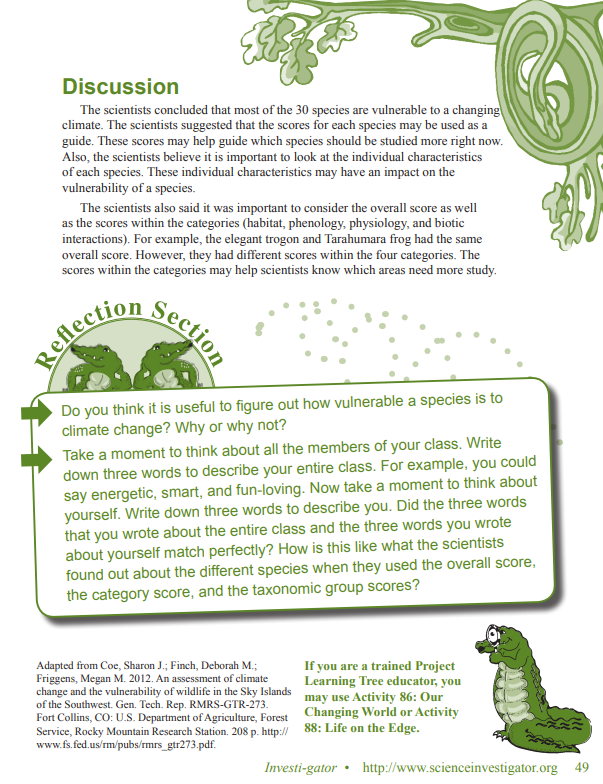
    A sample Discussion page from an Investi-gator article

Additional Resources on the Website

A screenshot of the related content tab for an Investi-gator articleOn the website, we pair each journal with a variety of other resources, as well. Use the tabs on the product page to browse through the following:

  • Related activities, including the FACTivity for each article
  • An “About” essay that gives some larger context for the research the scientists conducted or more information about the science topic from the journal
  • A glossary of all boldfaced terms from the journal
  • A “Scientists and Collaborators” page that lists the people involved in the studies in the journal; click on a researcher to reach their bio page and see what other articles they might be featured in
  • A “Related Content” page that lists both Natural Inquirer resources about similar topics and also outside reference materials

Article Selection and Review

Natural Inquirer partners with the USDA Forest Service, so we source research studies by Forest Service scientists that have been peer-reviewed and published in reputable journals. Some of our articles have also been created in collaboration with scientists from other Federal agencies, such as U.S. Geological Survey and the United Nations Food and Agriculture Organization, universities, and other non-profits.

All journal articles are reviewed by scientists who conducted the original research study to verify scientific accuracy. Journals are also reviewed by student editorial review boards of middle or high school students before publication. Additionally, all journals are reviewed by the Forest Service and the U.S. Department of Agriculture before publication.

A screenshot of the citation for Every journal article includes a citation of its source study. Many educators pair the original research paper with our article to help more advanced students learn how to read formal research papers. The journal article then serves as adapted primary literature, bridging the two articles.

Lessons

  • PDF Preview of Lesson Plan - Main Ideas from the Investi-gator (Northern Research Station)
    Introduce the scientific process, as expressed in scientific writing, to your students. This lesson plan will walk you through how to do a guided reading of an Investi-gator article (or...

    Lesson Plan – Main Ideas

    • Lesson Plan
    • Upper Elementary
    • 2-3 Classroom Periods
    • Active Forest Management
    • Agriculture
    • Carbon
    • Citizen Science
    • Engineering and Forest Products
    • Fire
    • Insects
    • Pollinators
    • Pollution
    • Recreation
    • Social Science
    • Water
    • Wilderness
    • Wildlife
    • Guided reading
    • Main Ideas
    • Reading Comprehension
    • Reading for Information
    • Summarize
    Introduce the scientific process, as expressed in scientific writing, to your students. This lesson plan will walk you through how to do a guided reading of an Investi-gator article (or...
    • Explore Lesson Plan
    • Download Lesson Plan (PDF)
    • Explore Lesson Plan
    • Download Lesson Plan (PDF)

    Part Of

    Investi-gator (Northern Research Station) - Vol. 1 No. 1

Education Files

Project Learning Tree

If you are a Project Learning Tree trained educator, you may use PLT Activity #42 “Sunlight and Shades of Green” as an additional resource.

Glossary

View All Glossary
  • anthocyanin

    (an(t) thə sī ə nən): Any of various soluble pigments producing blue to red coloring in flowers and plants.

  • chlorophyll

    (klȯr ǝ fil): The green coloring matter that is found chiefly in the chloroplasts of plants and is necessary for photosynthesis.

  • deciduous

    (di si jǝ wǝs): Having parts, like leaves, that fall off or shed seasonally or at a certain stage of development in the life cycle.

  • equation

    (i kwā zhǝn): A statement of the equality of two mathematical expressions.

  • hypothesis

    (hī pä thǝ sǝs): An assumption or idea that is proposed for the sake of argument so that it can be tested to see if it might be true.

  • nitrogen

    (nī trə jən): A colorless tasteless odorless element that occurs as a gas which makes up 78 percent of the atmosphere and that forms a part of all living tissues.

  • observation

    (äb sәr vā shәn): An act of recognizing and noting a fact or occurrence often involving measurement with instruments.

  • Dr. Schaberg hiking in the snow

    Paul Schaberg

    Plant Physiologist

    My favorite science experience is getting an unexpected result to an experiment. Sure, it is great to develop a hypothesis and test it in an experiment. A hypothesis is an...
    View Profile
  • Ms Murakami on a rock with two boys

    Paula Murakami

    Biological Sciences Lab Technician

    My favorite science experience is the opportunity to learn new things! Whether it is in the laboratory or in the woods, there is always something new to be discovered. Recently...
    View Profile
  • Dr. Shane shows students leaves on a tree branch.

    John Shane

    Professor of Forestry

    My favorite science experience was figuring out the movements of the Moon and their effects on the Moon’s nightly arc over all different moon phases and seasons. It was the...
    View Profile
  • Natural Inquirer bee with a magnifying glass

    Abby van den Berg

    Professor of Plant Biology

    I currently do research on the maple sugaring process. One of my favorite science experiences is talking to maple sugarmakers about the results of a research project. It’s a great...
    View Profile

Jump To

  • Additional Resources

Additional Resources

  • "Six artsy, nerdy, and goofy ways to enjoy fall leaves"

    Read this Forest Service article to learn some fun activities to do with your leaves!

    Read Article
  • USDA Forest Service: "The Science of Fall Colors"

    For years, scientists have worked to understand the changes that occur in trees and shrubs during autumn. Although we don’t know all the details, we do know enough to explain the basics to help you enjoy nature’s multicolored display.

    Visit Website
Back to Top
  • Natural Inquirer - Homepage
  • USDA
  • USDA Forest Service logo.

The Natural Inquirer program produces a variety of science education materials for PreK through grade 12. Natural Inquirer products are produced by the USDA Forest Service and other cooperators and partners.

Please enable JavaScript in your browser to complete this form.
* denotes mandatory fields
Loading
  • Facebook
  • Pinterest
  • X, formerly Twitter
  • YouTube
  • About Natural Inquirer
  • Team
  • Partners
  • Press & Past Events
  • Contact Us
  • Accessibility Policy
  • Privacy Policy
  • Shipping Policy
© 2026 - Natural Inquirer | Website Credit