


Welcome to our website’s resource library, where we offer an extensive collection of free science materials tailored for K-12 students. Dive into a wealth of educational resources including articles, activities, lesson plans, learning modules, and much more. All materials are free to download!

In this FACTivity, students will use information from the U.S. Environmental Protection Agency’s Sun Safety UV Index, formerly known as…
In this FACTivity, students will use information from the U.S. Environmental Protection Agency’s Sun Safety UV Index, formerly known as the Sunwise program. Students will record the daily UV Index...

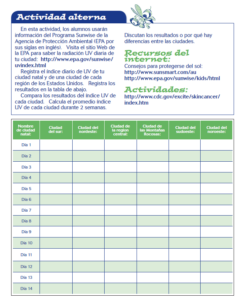
In this FACTivity, students will use information from the U.S. Environmental Protection Agency’s Sun Safety UV Index, formerly known as…
In this FACTivity, students will use information from the U.S. Environmental Protection Agency’s Sun Safety UV Index, formerly known as the Sunwise program. Students will record the daily UV Index...

The question you will answer in this FACTivity is: What can you learn from data about gage height and streamflow…
The question you will answer in this FACTivity is: What can you learn from data about gage height and streamflow for a stream for an extended period of time? You...


In this FACTivity, you will use the data provided in a table to calculate the results of a planting program…
In this FACTivity, you will use the data provided in a table to calculate the results of a planting program in Hawai’i. Then you will pretend that you are in...


In this FACTivity students will perform an experiment with a cardboard box, packing peanuts and thermometers. They will determine the…
In this FACTivity students will perform an experiment with a cardboard box, packing peanuts and thermometers. They will determine the different temperatures between outside the box, inside the box, and...

In this FACTivity, you will assess and compare two trees. The questions you will answer are: 1) What is the estimated…
In this FACTivity, you will assess and compare two trees. The questions you will answer are: 1) What is the estimated leaf area of two similar trees in your schoolyard? 2)...


In this set of two FACTivities, you will first compare a cactus, a fern, and another plant you select to…
In this set of two FACTivities, you will first compare a cactus, a fern, and another plant you select to determine how the plants are adapted to their native environments....


In this set of two FACTivities, you will first compare a cactus, a fern, and another plant you select to…
In this set of two FACTivities, you will first compare a cactus, a fern, and another plant you select to determine how the plants are adapted to their native environments....


In this FACTivity, you will answer the following question: Does viewing a photograph of a flower provide a benefit to…
In this FACTivity, you will answer the following question: Does viewing a photograph of a flower provide a benefit to students taking a math quiz? The following are methods you...


In this FACTivity, you will create a model of what happens to things in a river when a flood occurs.…
In this FACTivity, you will create a model of what happens to things in a river when a flood occurs. Scientists often create models to help them understand better how...


To better understand songbird habitat, Dr. Saab wanted to look at the big picture. In this FACTivity, we are going…
To better understand songbird habitat, Dr. Saab wanted to look at the big picture. In this FACTivity, we are going to make observations at different scales, just like Dr. Saab....
