


Welcome to our website’s resource library, where we offer an extensive collection of free science materials tailored for K-12 students. Dive into a wealth of educational resources including articles, activities, lesson plans, learning modules, and much more. All materials are free to download!

In this essay, learn about the ancient Chamoru culture of Guam and their unique method of building homes.
In this essay, learn about the ancient Chamoru culture of Guam and their unique method of building homes.


Create your own new vocabulary words. Identify your new word’s part of speech, pronunciation, and definition. This activity was originally…
Create your own new vocabulary words. Identify your new word’s part of speech, pronunciation, and definition. This activity was originally published with “The Morel of the Story” and centers on...


In this FACTivity, you will create a management objective for your schoolyard. Then you will create an adaptive management process.…
In this FACTivity, you will create a management objective for your schoolyard. Then you will create an adaptive management process. Materials: Paper Pencil


The questions you will answer in this FACTivity are: What similarities and differences do you notice between bird songs? How…
The questions you will answer in this FACTivity are: What similarities and differences do you notice between bird songs? How does the way a song sounds have an effect on...


The question you will answer in this FACTivity is, “Should forest managers allow mountain biking in potential wilderness areas?” To…
The question you will answer in this FACTivity is, “Should forest managers allow mountain biking in potential wilderness areas?” To answer this question, you will read background information about the...


In groups, you will develop a taxonomic structure for a category of objects. The question you will answer in this…
In groups, you will develop a taxonomic structure for a category of objects. The question you will answer in this FACTivity is: How are taxonomic structures useful to people?


In this FACTivity, students will use information from the U.S. Environmental Protection Agency’s Sun Safety UV Index, formerly known as…
In this FACTivity, students will use information from the U.S. Environmental Protection Agency’s Sun Safety UV Index, formerly known as the Sunwise program. Students will record the daily UV Index...

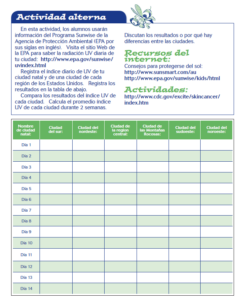
In this FACTivity, students will use information from the U.S. Environmental Protection Agency’s Sun Safety UV Index, formerly known as…
In this FACTivity, students will use information from the U.S. Environmental Protection Agency’s Sun Safety UV Index, formerly known as the Sunwise program. Students will record the daily UV Index...
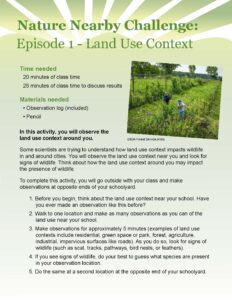
After watching episode 1 of Ecosystems LIVE about human impacts on mammals, you can try this Nature Nearby Challenge. In…
After watching episode 1 of Ecosystems LIVE about human impacts on mammals, you can try this Nature Nearby Challenge. In this activity, you will observe the land use context around...


Use this graphic organizer to guide students through Episode 1 of Ecosystems LIVE. Topics include biotic and abiotic factors of…
Use this graphic organizer to guide students through Episode 1 of Ecosystems LIVE. Topics include biotic and abiotic factors of ecosystems, the difference between biodiversity and species abundance, and a...

Use this graphic organizer to guide students through Episode 2 of Ecosystems LIVE. Topics include biotic and abiotic factors that…
Use this graphic organizer to guide students through Episode 2 of Ecosystems LIVE. Topics include biotic and abiotic factors that affect insects and arachnids in their ecosystems, the benefits insects...


Use this graphic organizer to guide students through Episode 3 of Ecosystems LIVE. Topics include safety tips for investigating animals,…
Use this graphic organizer to guide students through Episode 3 of Ecosystems LIVE. Topics include safety tips for investigating animals, using our senses to identify animals, animal tracks and scat,...
