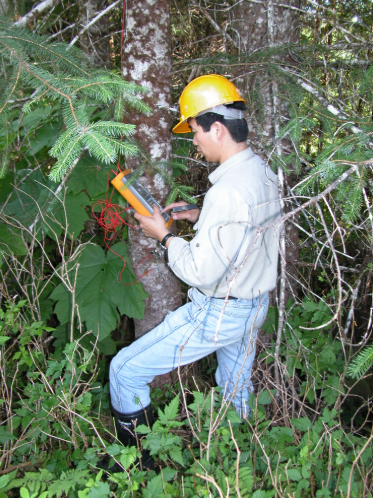
A research engineer studies the wood quality of raw forest materials, such as trees, stems, and logs.
Careful observation and critical thinking play the most important roles in my research success.
How can trees and logs be effectively graded and sorted according to their suitability for different products? My work focuses on developing new non-destructive evaluation methods. These new methods help scientists and forest managers better understand how species, site, silviculture, and genetics affect natural properties of wood.
Acoustic velocity is the speed of sound through a material. We proved that acoustic velocity can measure stiffness and strength of wood in trees. This breakthrough has resulted in one domestic patent and three foreign patents. A commercial tool (Hitman ST300) has been developed using acoustic velocity for tree quality assessment.
Discovering that the way sound waves travel in a standing tree is directly linked to the natural wood and fiber properties of the tree.
I knew I wanted to be an engineer during my Ph.D. work at Michigan Tech. I was experimenting with different ways of measuring acoustic velocity in trees. I was intrigued that a simple hit on a tree trunk can reveal so much about the wood — a phenomenon I still investigate.