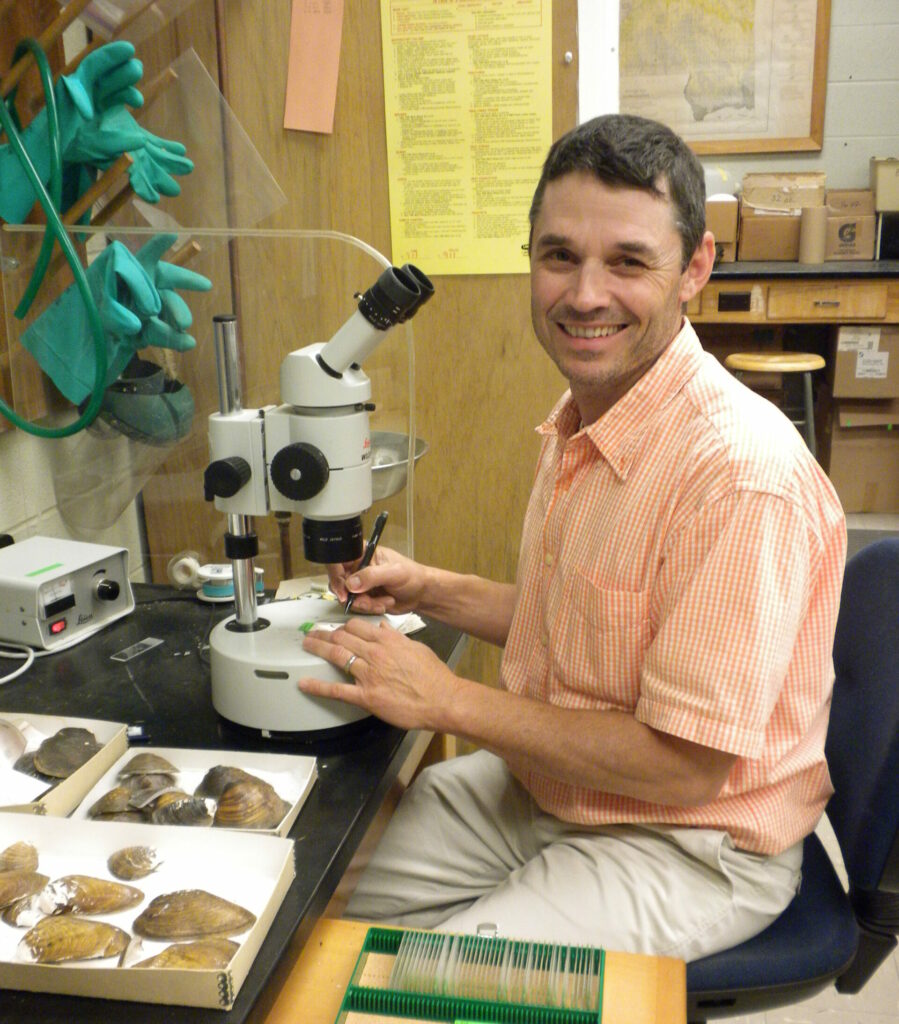
As an aquatic ecologist, I study animals that live in rivers and lakes and how they interact with each other and their habitats.
I think curiosity, critical thinking, and creativity are my most important skills. You’ve got to be curious to be a scientist, but critical thinking is also important so you don’t automatically believe everything you read. Creativity helps you see things in different ways and makes your work more interesting to other people.
How does mussel reproduction work, and how is it affected by various changes that people have made to aquatic habitats? For example, I’ve done experiments to see how fertilization of mussel eggs and survival of baby mussels is affected by water pollution.
I use a device called a hookah rig to dive for mussels. It has an air compressor mounted on an inner tube and a hose with a regulator that I breathe from. This works better than scuba diving because I don’t have to lug heavy air tanks. We also use microscopes and equipment to measure water quality.
My most exciting discovery was learning just how different mussel species are from each other. People used to think mussels were pretty boring and that all mussels lived the same way. It turns out that some species live only 5 years but others live over 100 years. They also do all kinds of cool things we didn’t know about.
I knew I wanted to be a biologist by the time I was about 14.