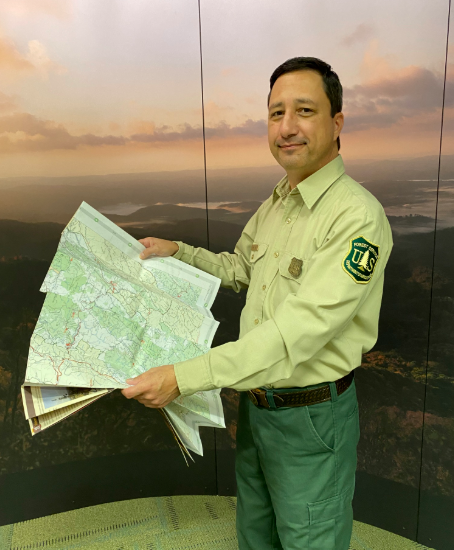
A district ranger is a leader within the Forest Service and local communities who is responsible for providing the goods and services that result from the multiple uses of national forests for current and future generations.
District rangers are generalists and need to know about many disciplines in order to direct those programs. My negotiation and facilitation skills are critical. Expertise in explaining complex Federal programs to colleagues, partners, and to the public is needed often.
Many challenges can be resolved with a science-based approach, such as creating wildlife habitat by managing tree species through timber harvest. Monitoring different activities, such as hiking and ATV riding, can be a challenge as I work to establish equal access for everyone to enjoy their national forest lands.
I utilize a variety of technology and equipment such as maps, compasses, and GPS units to lay out projects; clinometers to measure slope of terrain or tree height; radios and cell phones to communicate in the field; and fire weather meters and drip torches to perform prescribed burns.
American Indian Tribal lands are located adjacent to my forest. I am excited to work with Tribal Nations on using traditional ecological knowledge to bring fire back to fire-adapted landscapes and a program to trap and study wolf populations on the forest.
I began my career as a partnership coordinator and was somewhat overwhelmed by the career paths offered by the Forest Service. Within the first year or two, I wanted to be a district ranger after working with other rangers in the field and office.