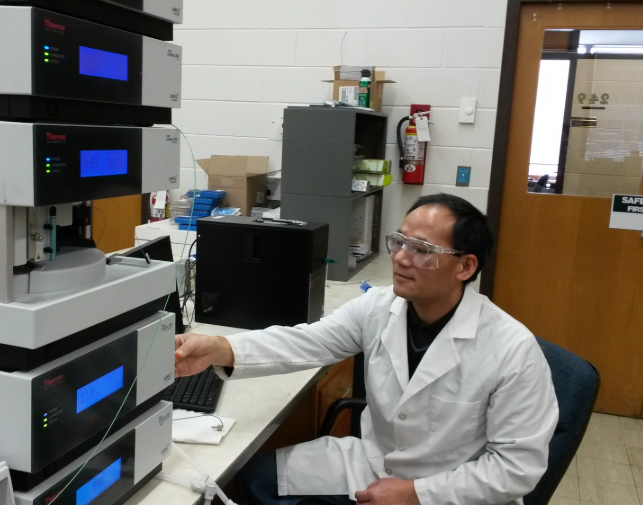
As a research general engineer, I study things such as chemical and biochemical engineering, wood and fiber science, and bioenergy.
Mathematics and critical thinking skills provide analytical abilities to define a complex, practical problem in a few key steps. Lifelong learning skills are essential, such as acquiring new knowledge to adapt to new scientific problems and research areas. Creativity is also important to address each step of the scientific method.
Is there a chemical process to treat forest residue for effective conversion to simple sugar (same as the sugar we use daily) and biofuel?
I developed a chemical process that can use a paper mill pulping digester to treat unusable wood pieces. These pieces are then converted to simple sugar and biofuel through bioconversion, a process using enzymes and microorganisms to carry out biochemical reactions with wood.
Lignin is part of the cell wall of many plants. Lignin repels water to prevent wood from being easily damaged. I found that lignosulfonate, a commercial lignin product from a papermaking process, can improve simple sugar production from wood using enzymes. This discovery is important to reduce the cost for simple sugar and biofuel production from wood pieces.
During my high school years right after the Cultural Revolution in China, science became noble again. There was a documentary news report about a famous Chinese mathematician who solved the Goldbach Conjecture (an old famous math problem), which really inspired me.