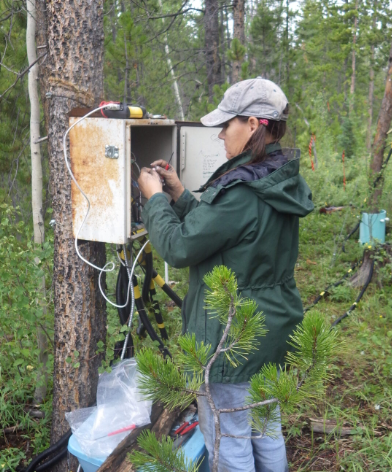
As a forestry technician in the research field, my work is a balance of field work (i.e., collecting samples, taking measurements, and downloading dataloggers), lab work (i.e., sample preparation and analysis), and data processing (i.e., creating spreadsheets, charts, and graphs).
My organizational skills and attention to detail are very important to my research. The quality and accuracy of research data is key to successful publications and presentations.
How do forest management actions affect the carbon balance within the soil, water, and air of a forest ecosystem? The unit for which I work studies carbon sequestration within a forest watershed. Carbon sequestration is the removal of carbon dioxide from the atmosphere for long-term storage in plants and soils.
Dataloggers are machines which automatically collect data in the forest, usually at set times. Dataloggers can record air and soil temperatures, soil moisture, and the water level below the soil surface. Some dataloggers collect meteorological, or weather, data like relative humidity, wind direction, wind speed, and solar radiation.
In this job, I have abundant opportunities for training and travel. I have received training to help me in my current position as well as future positions in which I am interested. I enjoy traveling for work. Traveling has given me the opportunity to work in my local national forest as well as many other forests across the United States. I even had the opportunity to work on a wetlands restoration research project in Africa.
I have always enjoyed being outdoors. Working with the Forest Service has allowed me to conduct science research projects with the national forests as my laboratory.