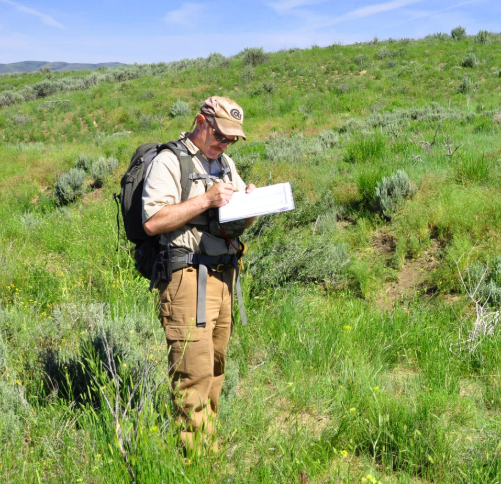
As a wildlife biologist, I study wildlife and how they interact with the ecosystem. I monitor animal populations and habitats, and I organize projects to improve habitat.
Two important things are my passion for wildlife and wild places, and my ability to express myself in writing. (Though, English and writing were something I struggled with in junior high and high school!)
What are the most critical habitat features for sage-grouse (a type of bird) to nest and successfully raise their young on the Curlew National Grassland?
Two important pieces of equipment are Global Positioning System (GPS) tracking collars and geographic information systems (GIS). We capture animals and place GPS tracking collars on them, then release them into the wild. This technology enables us to follow their movements and interactions with the environment. GIS is a computer mapping technology that enables us to measure and analyze the animal movements, as well as map habitats, ranges, vegetation, and other information.
I discovered the world-record-sized curlleaf mahogany tree (Cercocarpus ledifolius) on the Pahvant mountain range in Utah.
When I was a young teenager, I knew I wanted to be a wildlife biologist and work in the outdoors. At the time, I struggled in school, probably because I couldn’t see the connection between what we were learning and the fascinating real world. I never would have believed I would be in school for another 10 years, but it was worth it!