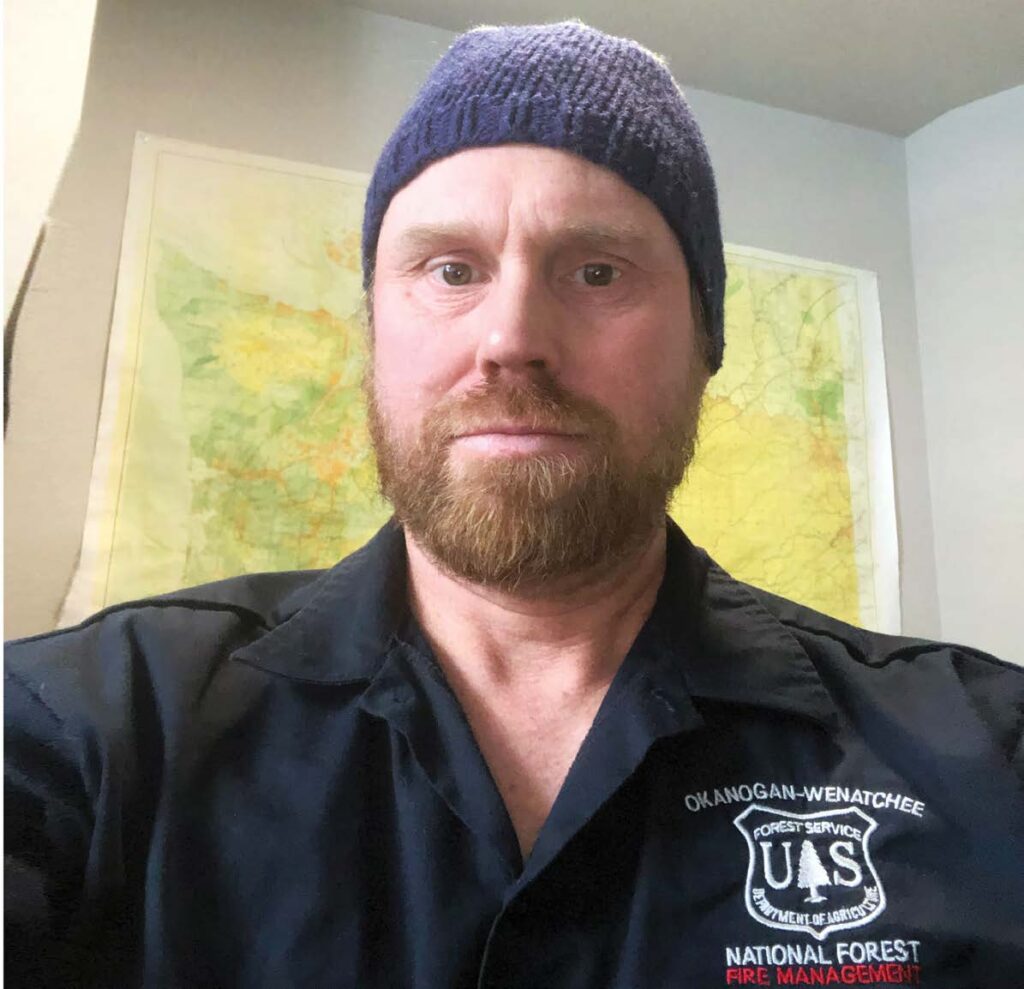
Aaron Rowe, Forest Fuels & Fire Prevention Specialist
B.S., University of Washington
USDA Forest Service
My job is to implement effective fuels treatments to make a more fire-resilient and fire-adapted landscape as well as prevent unwanted human-caused wildfires.
Bringing internal and external partners together for mutual benefit across the landscape, regardless of jurisdiction, is something that is much needed in my profession whether as a proactive fuels’ treatment or in a wildfire situation.
Challenges include land management policy and regulatory hurdles that are both internal and external when designing and implementing effective fuels treatments.
Advanced mapping programs, satellite or fixed imagery/detection, Remote Automated Weather Stations (RAWS), and unmanned aircraft systems (UAS or drones), in combination with other computer software programs, are becoming more typical to help us detect, map, predict, and plan for fires.
I’ve learned how relationships are key to making things happen on the ground in both prescribed and wildland fire environments.
Growing up, I was exposed to the outdoors in many scenarios. While in college, I came to the conclusion that I wanted to work in the outdoors in a forested setting. While on my first fire assignment with the Forest Service, I traveled to Nevada and California, burned many acres, and was hooked.